Engineering a Water-Secure Future: Rural Youth as Water Innovators in Kenya







E-STEM Stories: Branching Out shares stories of innovative E-STEM work from around the world. E-STEM engages students in meaningful, real-world environmental problem-solving that integrates science, technology, engineering, and math (STEM).
This post highlights the Riley Orton Foundation, a 2024 recipient of a Global E-STEM Award. These awards, which support both new and established global E-STEM initiatives, are made possible by Pratt & Whitney and the North American Association for Environmental Education (NAAEE).
This blog post was written by Monica Adhiambo, director of programs at the Riley Orton Foundation (ROF).
The Riley Orton Foundation's (ROF) Climate Solutions project educates youth from rural schools in Kenya to design and build solar-powered water purification systems. Through STEM workshops, students learn renewable energy and IoT (Internet of Things) technologies, addressing clean water access while promoting environmental sustainability and empowering future innovators.
In 2024, the ROF was honored as a Global E-STEM Awards Winner. For us, this recognition was more than an award; it was an affirmation that young people in rural Kenya deserve access to the tools, mentorship, and confidence required to solve the environmental challenges shaping their daily lives.
Across Western Kenya, water insecurity is not an abstract concept discussed in policy forums. It is a lived reality. Families rely on seasonal rain, shallow wells, rivers vulnerable to contamination, and boreholes that sometimes run dry. At the same time, many students in rural and informal settlement schools have limited access to hands-on STEM learning. Science is often taught theoretically, without laboratories, devices, or opportunities to experiment. STEM becomes something to memorize rather than something to build with.
Girls, in particular, face layered barriers, social messaging that STEM is “for boys,” limited mentorship, and fewer opportunities to lead technical projects. Through our Climate Solutions Program at Akili STEMarts Academy, we set out to address these gaps simultaneously: expanding access to meaningful STEM education while grounding it in real-world problem solving.

A STEM Facilitator shows students how to design Arduino projects. Photo credit: Riley Orton Foundation
From Classroom Lessons to Community Solutions
With support from the E-STEM Award, we engaged 1,031 students and 326 teachers in a year-long initiative organized around a single theme: Engineering a Water-Secure Future.

Volunteer teachers assist students at a STEM camp. Photo credit: Riley Orton Foundation
Instead of isolating coding from community realities, or teaching robotics as a stand-alone skill, we anchored every lesson in a question students understood deeply: How can we make water safer, more accessible, and more sustainable in our communities?
Students learned to code not for abstraction, but to automate irrigation systems. They explored sensors not as gadgets, but as tools to detect unsafe water. They studied solar energy not as theory, but as a reliable power source for purification and conservation systems in areas where grid electricity is unreliable.
The transformation was immediate. STEM stopped being intimidating. It became purposeful.
Student Innovation in Action
In Kisumu West Sub-county, a community where many households depend on river water and shallow wells, one student team began by asking why families continued to drink unsafe water even when filtration options existed. The problem, they discovered, was inconsistency. Water quality changes daily, and most households cannot test it.
From that observation, the team built a Smart Filter Station using an Arduino Uno, turbidity sensors, pumps, and an LCD display. Their system continuously measures water clarity. When contamination crosses a certain threshold, the filtration system activates automatically. In demonstrations, students explained how their low-cost prototype mirrors the logic of industrial water treatment plants, but scaled for community use. For households without laboratory testing, this could mean safer drinking water and fewer waterborne illnesses.
Another group, thinking about the erratic rainfall patterns affecting smallholder farmers, focused on agriculture. They watched family members irrigate crops manually, often overwatering or wasting precious reserves. Their response was a solar-powered Smart Drip Irrigation System controlled by soil moisture sensors and an ESP32 microcontroller.
When soil moisture drops below optimal levels, the system activates drip lines. When the soil is sufficiently hydrated, irrigation stops automatically. In a region where rainfall is unpredictable and water access can determine whether crops survive, this simple automation conserves water, reduces labor, and protects yields. Students did not just build a device; they built resilience.

Students share their solar-powered Smart Drip Irrigation System projects. Photo credit: Riley Orton Foundation
One of the most compelling innovations came from a team concerned about wasted rainwater. During heavy storms, storage tanks overflow, causing water that could sustain families through dry spells to simply spill away. The students designed a Smart Rainwater Harvesting System equipped with an ultrasonic sensor to monitor tank levels in real time. When the tank reaches capacity, LED alerts activate, and a GSM module sends an SMS notification to the household.

Students present their water security projects at a STEM camp. Photo credit: Riley Orton Foundation
In a rural context, where mobile phones are common but smart infrastructure is rare, this blend of low-cost hardware and communication technology represents practical, accessible innovation.
Another team tackled a less visible but equally pressing issue: wastewater. Recognizing that greywater from washing dishes and clothes is often discarded, they engineered a Greywater Recycling System that uses turbidity sensors to assess water quality and determine whether it can be safely redirected for irrigation or cleaning. In water-stressed communities, reusing even small amounts of water reduces pressure on boreholes and rainwater reserves.
Even younger students contributed meaningfully. Using Scratch, an interactive programming language for kids, they created animated stories illustrating the journey of a polluted river transformed through conservation efforts. These projects strengthened computational thinking and communication skills, while turning environmental advocacy into something creative and relatable.
What united all these innovations was not just technical competence, but ownership. Students were not replicating textbook experiments. They were responding to challenges they see every day.
As one participant shared:
“STEM is no longer just a subject; it is a way to solve real-life issues like water scarcity in my community.”
Shifting Mindsets, Especially for Girls
Throughout the program, girls stepped forward as coders, engineers, and presenters. In team competitions, they wired sensors, debugged code, and confidently explained circuitry and algorithms to judges.
By pairing mentorship with inclusive team structures, we disrupted the narrative that engineering is a male domain. Confidence grew alongside competence. Girls who once hesitated to handle electronics began leading demonstrations and fielding technical questions with authority.

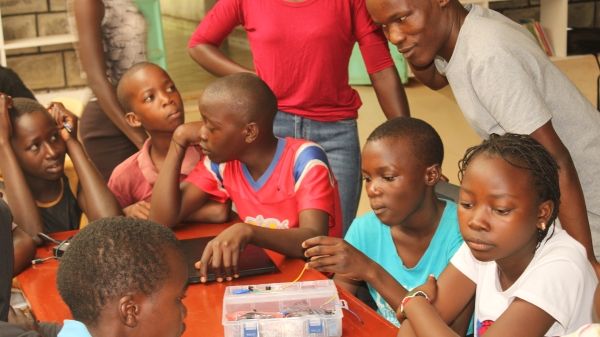
Students work on a group project. Photo credit: Riley Orton Foundation
Teachers as Multipliers
Sustainability was built into our model. We trained 326 teachers in robotics, coding, AI, 3D printing, and environmental pedagogy. These educators now run school-based STEM clubs independently, integrating environmental problem solving into everyday lessons. The impact therefore extends beyond one camp cycle. It lives on in classrooms where students continue experimenting, building, and iterating solutions long after the program ends.
E-STEM as a Catalyst for Rural Transformation
This initiative demonstrates what happens when environmental literacy, renewable energy, and hands-on STEM converge. Students in rural Kenya, often excluded from high-tech ecosystems, are proving they can design solutions that are locally grounded and globally relevant.

Students code with Scratch. Photo credit: Riley Orton Foundation
When a student learns to test water quality with a sensor, automate irrigation with code, or reuse greywater through intelligent systems, they are not only gaining technical skills, they are building agency. They are redefining what is possible in their communities.
The E-STEM Award strengthened our capacity to nurture this agency at scale. As we look ahead, we will expand STEM clubs, deepen focus on climate-smart agriculture and food security, and continue connecting innovation to real environmental challenges.
A water-secure future will not be engineered in distant laboratories alone—it will be designed in classrooms, in villages, and in the hands of young people who believe they have the power to change their world.