We Are the Land: How Art Changes Hearts





In the CEE-Change, Together blog series, NAAEE shares narratives from the CEE-Change Fellows as they implement their community action projects and work to strengthen environmental education and civic engagement capabilities, all supporting the mission of cleaner air, land, and water. Join us on their journey! The Civics and Environmental Education (CEE) Change Fellowship is NAAEE’s initiative to support leadership and innovation in civics and environmental education in North America and beyond.
The 2025 U.S.-based CEE-Change Fellowship Program is supported by generous funding from ee360+, the Cedar Tree Foundation, the Sam and Mary Lawrence Foundation, and the Weeden Foundation. The 2025 International CEE-Change Fellowship Program is a partnership between NAAEE and the Global Environmental Education Partnership (GEEP).
Long before Compton became a city, a great California sycamore stood near what is now the corner of Poppy Street and Short Avenue. Known as the Eagle Tree, it was named after the birds that once gathered in its branches, and the tree served as one of the most recognizable natural landmarks in the area for generations. Unfortunately, during a hazy night on April 7, 2022, the trunk of Compton’s historic Eagle Tree collapsed onto a nearby car. To some, this marked the end of one of Compton’s oldest living landmarks. To me, it was a delayed wake-up call.
Despite being a born and raised Compton native, I was unaware of the tree’s existence (let alone its demise) until autumn 2023. My vocabulary fails to capture the cluster of emotions I felt reading about these recent events long-past, but shame, guilt, frustration, and ignorance come pretty close. How could I call myself an “environmentalist” if I couldn’t even keep track of what was going on in my own proverbial backyard. As an aspiring science communicator, I studied environmental science in undergrad to hone my ability to warn urban communities of impending global changes and encourage them to take action. Learning about the Tree revealed to me that I had already grown complacent in my short career, and I lost sight of the goal that had driven me up until that point. But Glory to God, my story doesn’t end there.
For over a year, I silently reflected on the loss of the Eagle Tree, not really knowing what I should do or if there was even anything I could do. As luck would have it (or perhaps fate to some), I learned about the CEE (Civics and Environmental Education)-Change Fellowship coordinated by the North American Association for Environmental Education (NAAEE). The Fellowship caught my eye because each Fellow is tasked with a grant-funded Community Action Project (CAP), using both civic engagement and environmental education strategies to address a local civic and environmental issue. I was admittedly intimidated by the program, since it seemed that some of the most creative and impactful individuals in the field had passed through the Fellowship. Previous Fellows seemed so confident in their work, and even more so in themselves. In full transparency, that confidence was a foreign concept to me, but I knew I couldn’t let an opportunity to produce change in Compton pass me by. I couldn’t let another “Eagle Tree” fall. With a swell of inspiration I hadn’t felt in a while, I made a bold request to my leadership at the Compton Art and History Museum: let me curate an exhibit exploring the history of environmentalism in Compton that would double as my CAP.

Archival photo of “Eagle Tree” used as marker for the northern boundary of Rancho San Pedro, near Poppy and Short Streets, Compton. 1952. Photo credit: CSU Dominguez Hills Archives
While a team member of the museum since its opening in February 2023, I had always played a supportive role, helping with setup and maintenance. I was never involved with the creative development of an exhibit, and quiet as kept, I’m not artistically inclined in the slightest. I am, however, a lifelong appreciator of the artistic process, and more than anything, a zealot for a well-crafted story. Rooted in those two passions, I pitched the vision God gave me to the Museum’s founders, Abigail Lopez-Byrd and Mark Byrd, hopeful that the promise of grant funding would fortify my request. Ever the avant-garde thinkers, the Byrds latched on to the idea, which did more for my confidence than they could ever know. So with their approval and support, I applied to the CEE-Change Fellowship. In spite of my imposter syndrome and anxious heart, I was accepted and joined my fellow Fellows at the August 2025 Leadership Institute in West Virginia, where I was humbled by their commitment to expanding their respective communities’ understanding of environmental issues. I returned home with a renewed sense of purpose and an excitement for what was to come.

Save the Date flyer for "We Are the Land." Image credit: Compton Art and History Museum
After months of planning, meetings, disputes, late nights, and hot chocolate (I’m not a coffee drinker), it all came together. We Are the Land is an art and history exhibition curated by my colleague Yaileen Zamora and myself that explores the wins and woes of environmental stewardship in Compton and the surrounding communities through a dynamic blend of visual art, archival material, and spatial storytelling. The exhibition features a range of art forms and materials that bring the theme of our local land as a memory book to life, and explores how public spaces and neighborhood landmarks carry stories that connect people to places. Archival materials tied to Compton’s Eagle Tree anchor the exhibition in a powerful local symbol, illuminating the relationship between history, memory, and environmental significance. Paintings provide interpretive and expressive visions of landscapes, environmental changes, and a collective community identity. Submitted photographs from recent community events document stewardship as a living practice, capturing the people, places, and moments that continue to define environmental care in the present.
At its core, the exhibition centers environmental stewardship as both a historical afterthought and contemporary social imperative. It highlights how communities in Compton and across Southeast Los Angeles have navigated pollution, disinvestment, limited access to green spaces, and other environmental burdens, while also creating their own traditions of care, advocacy, and resilience, many of which have bloomed over the decades. Rather than presenting these communities exclusively through the lens of struggle, the exhibition emphasizes communal confidence, creativity, and conscientiousness. We asked visitors to consider what it means to love a place, to fight for its well-being, and to pass those values on across generations. The exhibition then uses those questions to reveal to visitors the duality of humanity’s relationship with the natural environment, while hopefully inspiring them to be agents of change toward a more sustainable future.
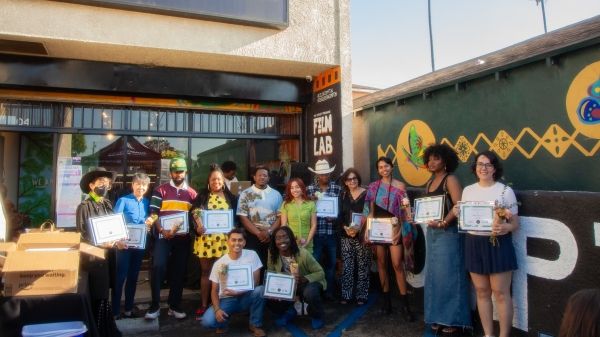
To celebrate the exhibition, an opening reception was held on June 6, 2026. The event brought together over 100 community members, artists, families, educators, environmental advocates, and supporters of local arts and culture, with some attendees traveling from as far as San Diego to experience the art. The reception created exactly the kind of gathering space I hoped the project would make possible: one where people could engage with environmental issues through art, memory, storytelling, and shared community experience. Artists had the opportunity to stand with their work and speak directly with attendees about what inspired their pieces, while visitors reflected on their own relationships to land, place, neighborhood change, environmental harm, and community care.

Co-curators pose for a picture with many of the artists featured in "We Are the Land" in front of Compton Museum. Photo credit: Compton Art and History Museum
Since the opening, I have continued to reflect on how powerful it is when environmental education is rooted in the lived experiences of the people most connected to the issues being discussed. The community reception has been deeply positive, particularly because the exhibit does not frame Compton only through its deficits or infamy. Instead, it honors the beauty, creativity, resilience, and stewardship that already exist here. For so many, the exhibit seemed to offer both recognition of the environmental challenges they have noticed and long lived with, and the possibility that a healthier, more sustainable future is worth imagining. The opening confirmed that this work is about creating a space where community members can see themselves as part of the environmental story and as active participants in shaping what comes next.
We Are the Land began with my grief over a tree I never knew, but grief alone was never going to be enough. Sitting with the loss of the Eagle Tree forced me to confront a harder truth: if I could mourn what had disappeared, I also had a responsibility to help preserve what remains. That realization became the bridge between reflection and action. I did not want my sadness to end as a private feeling, or even as a well-written memory. I wanted it to become an invitation for others to look more closely, remember more intentionally, and take greater care of the places that have always been caring for us.
The Eagle Tree may have fallen, but its story is still teaching us. My hope is that this exhibition helps more of us pay attention before the next landmark disappears, before the next memory fades, and before the next generation inherits a community they were never taught to fully see. Compton is not separate from the land. We are shaped by it, responsible for it, and capable of healing alongside it.
If you’re ever near the Hub City, I encourage you to support the Compton Art and History Museum and the work it is doing to preserve, celebrate, and uplift our community’s stories. Visit the museum, bring someone with you, and consider making a donation so that spaces like this can continue to grow in Compton!