UE TUNA: The Achuar School Where the River Is the Classroom







E-STEM Stories: Branching Out shares stories of innovative E-STEM work from around the world. E-STEM engages students in meaningful, real-world environmental problem-solving that integrates science, technology, engineering, and math (STEM).
This post highlights Fundación Pachamama, a 2025 recipient of a Global E-STEM Award—Next-Generation Transportation Grant. These awards, which support both new and established global E-STEM initiatives, are made possible by Pratt & Whitney and the North American Association for Environmental Education (NAAEE).
Click here to read this blog in Spanish.
Kapawi and its school, Unidad Educativa (UE) Tuna, are located at the mouth of the Capahuari River where it meets the Pastaza River, right in the center of Achuar territory. In one of the most isolated educational corridors in the Ecuadorian Amazon, the waterway is the only road to connect approximately 170 Achuar students to modern education. Scattered throughout Achuar communities up and down the Pastaza basin, children travel distances only river navigation allows to attend UE TUNA. Attending school here is not a matter of a daily commute or a bus ride—many students reside at the school throughout the week, returning to their home villages only on weekends or when the circumstances allow.
Achuar communities, like many others in the broad Amazon region, live in a close relationship with the river. “Entsa,” the Achuar word for river, is commonly heard when you try to make out local dialogues and friendly chatter in this bilingual school. UE Tuna is located within the tens of thousands of hectares of conserved primary forest that surround the course of the rivers and spill into this broad watershed. Forest conservation has been key for the Achuar people, continuing to show its resilience in times of fast change. Generations of Achuar have inhabited this region for centuries and know better than anyone else its irreplaceable biological wealth. This diversity and biocultural heritage make the evergreen forest of the Tigre-Pastaza lowlands and the forests of the Pastaza floodplain some of the most unique ecosystems in Ecuador.
State-designated oil blocks overlap nearly 70% of Indigenous territories in this region, and the looming threat of oil operations taking residence in primary forest keeps the stewards of this land on their toes. Communities remain victims of the "Custodian Paradox": they protect the world’s most vital ecosystems while suffering from the lowest water and sanitation coverage in Ecuador.

Solar canoe project participants help haul the canoe to land, sanding and buffing surfaces. In this stage, they are understanding the fiberglass curing process and discussing hull design considerations. Photo credit: Bernardo Guarderas, Fundación Pachamama
This year, I could learn more about what STEM is and how it can help find solutions to the problems my community faces.
—U.E. TUNA Student
Through the Global E-STEM Awards’ Next Generation Transportation Grant, Fundación Pachamama has supported the Solar Canoe project, where a 10-meter canoe is fitted with solar panels, electric hardware, and an electric outboard engine. This canoe is the UE Tuna’s vehicle to use for any logistics or transport they might require. This boat will also be part of the school infrastructure, a place where learning can take place, too. In collaboration with Achuar students, this canoe has been reframed as a mobile classroom and laboratory.
By replacing outboard gasoline engines with solar energy, the students plan to use the canoe as a vehicle to access opportunities to learn outside of the school bounds. The project, in collaboration with the University of Azuay, incorporates crucial technical skills to train local students and adults. Furthermore, the project aims to foster a sense of local rootedness and avoid youth abandonment in communities through technology and access to opportunities. As part of the project, high school students have assessed their most pressing needs and structured a curriculum that includes:
- Solar and Electrical Engineering: Students maintain the very systems that power their transit, gaining skills in renewable energy applicable across the basin.
- Environmental Science: The boat serves as a monitoring station, allowing young people to monitor water quality and detect the presence of E. coli and species characteristic of the area.
- Telemetry Tracking: Establish the “UE Tuna” solar canoe as a learning platform with internet access and telemetry tracking to optimize transport in the area.
- Community Diagnosis and Assessment: Diagnose water access and quality, food sovereignty, the impact on livelihoods of tourism operations, and waste management.
While solar boats have navigated these waters previously, the Solar Canoe project is meant to be embedded in the school’s daily life. It aligns with our larger mission of Indigenous self-determination and bioregional conservation, the longstanding goal of Fundación Pachamama and its 30 years of work in Achuar territory. By increasing access to education through a transportation solution tailored to local conditions, we are creating a replicable model for remote Amazonian schools spread across 30 million hectares of the Sacred Basins of the Amazon River.

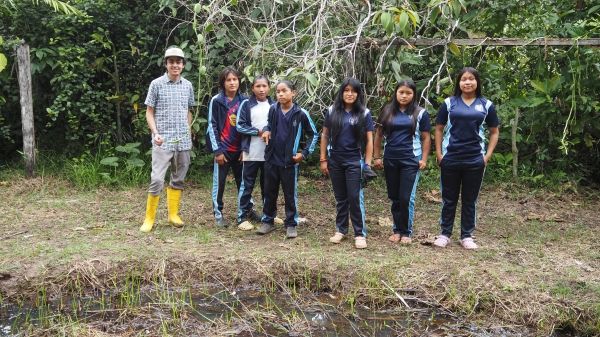
Water project participants are ready to collect and test samples from the Pastaza River. Photo credit: Bernardo Guarderas, Fundación Pachamama
Parents won't have to worry as much anymore, since we have someone to pick up their children… some students walk about 8 hours to get to school.
—Luis Mukucham, U.E. TUNA School Principal

Bernardo Guarderas from Fundación Pachamama introduces students to the concept of STEM, presenting on the importance of STEM education and environmental science. Photo credit: Bernardo Guarderas, Fundación Pachamama

Universidad del Azuay representative instructs student participants about collecting water samples and environmental data. Photo credit: Bernardo Guarderas, Fundación Pachamama

Students participate in a workshop aimed at developing student-led projects and environmental monitoring skills. Photo credit: Bernardo Guarderas, Fundación Pachamama

These vanilla nursery project participants monitor the growth of vanilla plants in this part of the school and will harvest vanilla pods. Photo credit: Bernardo Guarderas, Fundación Pachamama