From Fellowship to Civic Education: Empowering Students Through Civic Environmental Leadership





In the CEE-Change, Together blog series, NAAEE shares narratives from the CEE-Change Fellows as they implement their community action projects and work to strengthen environmental education and civic engagement capabilities, all supporting the mission of cleaner air, land, and water. Join us on their journey! The Civics and Environmental Education (CEE) Change Fellowship is NAAEE’s initiative to support leadership and innovation in civics and environmental education in North America and beyond.
The 2025 U.S.-based CEE-Change Fellowship Program is supported by generous funding from ee360+, the Cedar Tree Foundation, the Sam and Mary Lawrence Foundation, and the Weeden Foundation. The 2025 International CEE-Change Fellowship Program is a partnership between NAAEE and the Global Environmental Education Partnership (GEEP).
Last summer, I had the privilege of participating in a transformative professional development experience through the North American Association for Environmental Education (NAAEE). Selected as one of just 30 CEE-Change Fellows across North America, I joined a community of passionate educators dedicated to using civic engagement as a tool to address environmental challenges. At the time, I didn’t fully realize the magnitude of that opportunity. Looking back now, it feels like hitting the jackpot, not for me alone, but for the more than 100 middle school students who would soon benefit from the experience.
The five day Leadership Institute immersed us in meaningful discussions, collaborative problem-solving, and innovative approaches to environmental education. Inspired and energized, I returned to my school determined to translate that learning into action. What followed was a year-long journey of hands-on experiences, community partnerships, and student-led initiatives centered around one of our most vital natural resources: freshwater.
Glen Hills provides environmental education through a STEAM Program where students are given opportunities to design outdoor gardens and participate in biotic index and water testing. The fellowship experience gave me an opportunity to collaborate with our science team to add the civic leadership layer to environmental education. We designed a series of educational opportunities for K5–8th-grade students that provided opportunities for them to immerse in environmental education and gave an outlet to become leaders in the community. Our 7th- and 8th-grade students from science classes were given opportunities to showcase their learning at various community events, science fairs, and STEM conferences.
Living near the Milwaukee River gives our community a unique advantage and responsibility. To help students understand the importance of water conservation and environmental stewardship, we partnered with EarthEcho International and several local organizations. Together, we designed a series of immersive activities that integrated civic engagement, environmental science, and leadership development.
Our programming began in September with a series of outdoor learning experiences. On September 18, 2025, one hundred 8th-grade students participated in a canoe mobile field trip to Lake Michigan. This “floating classroom” experience allowed students to paddle 24-foot Voyageur canoes while exploring science, history, geography, and culture. Supported by the U.S. Fish and Wildlife Service and the National Park Service, the trip provided students with a powerful, firsthand connection to the natural world. Beyond learning technical skills, students developed a deep sense of environmental responsibility and began to see potential future careers in environmental fields.

Glen Hills Middle School students and Lalitha present at the SystemNow STEM Conference about their STEAM learning. Photo credit: Lalitha Murali
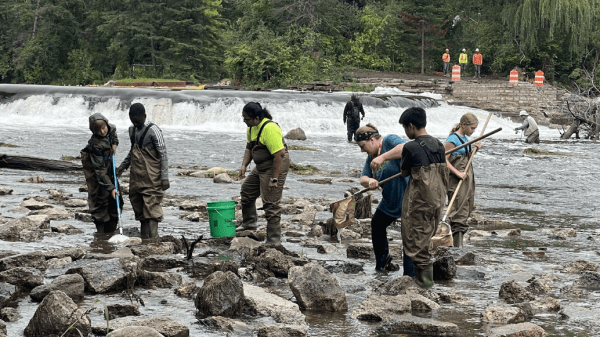
Just days later, on September 30, 2025, our focus shifted to hands-on scientific inquiry. One hundred 6th-grade students, along with twenty 7th- and 8th-grade STEAM students, visited the Milwaukee River at Kletzsch Park, where they conducted water testing, calculated biotic indices, and participated in a river cleanup. What made this experience especially meaningful was the leadership demonstrated by the older STEAM students. Having participated in similar activities in previous years, they stepped into mentorship roles, guiding younger students and reinforcing their own learning through teaching.
In October, our efforts expanded to include community education and awareness. On October 11, 2025, our STEAM program hosted an event focused on bats and their environmental significance, featuring a specialist from the Department of Natural Resources. More than 50 community members, parents, and students attended, highlighting the growing interest in environmental topics within our community. Again, our 7th- and 8th-grade STEAM students took leadership roles to organize and conduct various stations to educate our community on clean environment and indoor/outdoor gardens, and even pumpkin carving, painting rocks, and other art activities.
Later that month, on October 23, our middle school students became educators themselves. They visited Parkway Elementary School to teach younger students about clean water and environmental stewardship. With support from community partners like Milwaukee Riverkeepers and Milwaukee Metropolitan Sewerage District (MMSD), this cross-age teaching experience empowered our students to take ownership of their knowledge and share it in meaningful ways.
One of the standout moments of the year was our STEAM Fair on December 13, 2025. With over 300 attendees, the event brought together a wide network of community partners, including Schlitz Audubon, Discovery World, the Milwaukee Public Museum, and the University of Wisconsin–Madison Freshwater Science program. Through hands-on activities and interactive exhibits, families and community members engaged in learning about environmental sustainability, water conservation, and STEM innovation.
As the school year progressed, our students continued to explore environmental science through innovative projects. Our after school NASA STEM Club also provided opportunities for 4th–8th-grade students to participate in environmental education. In January 2026, approximately 100 students participated in a NASA-inspired experiment comparing the growth of tomato seeds that had traveled to space with those that had not. Using grow lights, natural sunlight, and hydroponic systems, students collected and analyzed data, developing both scientific and critical thinking skills. They also participated in Algae Academy, investigating how algae can help address climate change and food security challenges.

Lalitha Murali at a bat workshop organized by the Glen Hills STEAM Program. Photo credit: Lalitha Murali
Between February and March, the STEM club invited a fungi specialist from the University of Wisconsin-Madison to educate students about mushrooms to introduce STEM concepts like ecosystems, decomposition, and sustainability while fostering an appreciation for nature. Our students grew mushrooms in the classroom using the mushroom grow kits. Nine of them presented their experience and learning at the fungi expo at the University of Wisconsin Madison on April 27, 2026.
On March 24, 2026, we celebrated World Water Day with 200 elementary students, once again supported by our incredible community partners. This event reinforced the importance of water conservation and gave students a platform to showcase their learning.
Our commitment to environmental stewardship continued into the spring with a week-long celebration of Earth Day, featuring school-wide cleanup efforts and awareness activities. On April 26, National Junior Honor Society students participated in a river cleanup, followed by the Glen Hills Cleanup on May 2, where students removed weeds, plant greenery, and beautified the school grounds.
Looking ahead, we are excited to provide even more experiential learning opportunities. In early June, one hundred 5th-grade students will visit the River Edge Nature Center for the River Adaptations Program. There, they will step directly into river ecosystems, collecting macroinvertebrates and studying how these organisms survive and thrive in their environments.
Beyond the individual events, the true impact of this initiative lies in the skills and mindsets our students have developed. Through these experiences, students have practiced civic engagement, learned how to advocate for environmental protection, and even explored how to communicate with local representatives. They have analyzed real-world data, engaged in problem-solving, and built a deeper understanding of the environmental challenges facing their communities.
One particularly exciting highlight was when a group of 5th-grade students successfully applied for a KEEP Green Team Mini-Grant. Their project focused on reducing the school’s carbon footprint, and the grant will fund the purchase of LEGO SPIKE Prime kits that will further enhance STEM learning and innovation.
This journey would not have been possible without the continued support of NAAEE and our many community partners. Their collaboration has allowed us to provide meaningful, hands-on learning experiences that go far beyond the classroom.
What began as a five-day training has grown into a comprehensive, student-centered program that empowers young learners to become informed, engaged, and proactive environmental stewards. As we look to the future, we remain committed to expanding these opportunities and continuing to inspire the next generation to care for and advocate for the world around them.
Comments
Thanks so much for sharing! I look forward to learning more during your presentation about this project on July 7, 2026!