Bringing Ocean Science to the Far North: E-STEM Education in Coastal Aotearoa





E-STEM Stories: Branching Out shares stories of innovative E-STEM work from around the world. E-STEM engages students in meaningful, real-world environmental problem-solving that integrates science, technology, engineering, and math (STEM).
This post highlights the TriOceans Education Trust, a 2024 recipient of a Global E-STEM Award. These awards, which support both new and established global E-STEM initiatives, are made possible by Pratt & Whitney and the North American Association for Environmental Education (NAAEE).
This blog post was written by Thibaud Guerin, trustee and treasurer at the TriOceans Education Trust.
Along the northernmost coast of Aotearoa New Zealand, communities live intimately with the ocean. Fishing, boating, gathering kaimoana (seafood), and spending time on the water are everyday parts of life. Yet many young people growing up in these coastal communities have limited access to hands-on science education that helps them understand the marine environments surrounding them.
Through support from the Global E-STEM Awards by the North American Association for Environmental Education (NAAEE) and Pratt & Whitney, TriOceans launched an outreach program bringing experiential ocean science activities directly to schools and community groups across Northland, New Zealand.
Over the course of the program, we delivered 100 E-STEM sessions reaching around 900 individual students across approximately 20 schools and partner organizations. Most sessions took place in classrooms or community spaces where access to specialized science resources is often limited. Rather than traditional lectures, the program focused on interactive, inquiry-based learning, allowing students to explore marine science through hands-on activities connected to their local environment.

Hands-on ocean physics activities introduce concepts like wave dynamics and water movement in marine environments. Photo credit: TriOceans
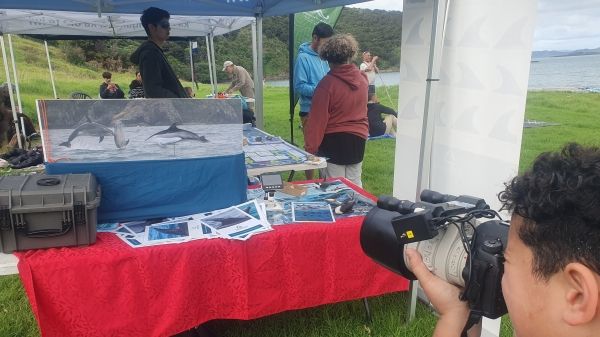
Students investigated water physics, experimenting with buoyancy, density, and pressure to understand how the ocean behaves and how marine animals move through it. Other sessions explored marine mammal research techniques, including how scientists identify individual dolphins using photo-identification methods.
Taxonomy activities introduced students to the diversity of marine life, while discussions around sharks, marine evolution, and biological adaptations helped illustrate how species survive and thrive in ocean ecosystems. We also explored ocean acidification and coastal erosion, linking global environmental challenges to changes occurring along Northland’s own coastline.

Students explore marine biodiversity through hands-on identification activities to understand species diversity and ecosystem roles. Photo credit: TriOceans
A central goal of the program was to connect science with the cultural and environmental values of the region. Many Northland communities hold strong relationships with the ocean, reflected in the Māori concept of kaitiakitanga—the responsibility of guardianship and care for the natural environment. Integrating this concept helped frame marine science not only as a field of study, but as a tool for stewardship. Students discussed how scientific understanding can support the protection of ecosystems that sustain their communities.
Partnerships played a key role in extending the program’s reach. Alongside schools, E-STEM sessions were delivered through libraries, holiday education programs, and youth initiatives, ensuring that learning opportunities were accessible beyond the classroom. One particularly memorable collaboration involved a charitable education sailing vessel where students engaged with ocean science while experiencing life at sea. Being physically on the water helped bridge the gap between theory and reality—allowing young people to connect scientific ideas with the environment around them. For many students, these sessions were their first direct exposure to marine research and ocean science careers. Activities such as dolphin photo-identification or ecological monitoring introduced them to the kinds of methods scientists use to study and protect marine ecosystems.
Programs like this are particularly meaningful in regions such as Northland, where communities are deeply connected to the ocean but may have fewer opportunities to engage with STEM education. By bringing environmental science directly into these communities—and grounding it in local knowledge and cultural values—E-STEM education can help empower young people to better understand and care for the ecosystems that surround them. The Global E-STEM Awards made it possible for us to reach hundreds of students who might otherwise never have experienced hands-on ocean science learning. The enthusiasm and curiosity shown by participants across the region highlighted the importance of continuing to invest in accessible environmental education.
As environmental challenges continue to grow globally, nurturing curiosity, knowledge, and stewardship among the next generation will remain essential. TriOceans Marine E-STEM 2025 demonstrates that meaningful science education does not always require laboratories or expensive equipment—sometimes it simply requires bringing the ocean into the classroom.

Students learn marine mammal disentanglement techniques and response strategies. Photo credit: TriOceans

Students investigate ocean chemistry through interactive experiments, exploring concepts such as ocean acidification.