Watershed Matters





E-STEM Stories: Branching Out shares stories of innovative E-STEM work from around the world. E-STEM engages students in meaningful, real-world environmental problem-solving that integrates science, technology, engineering, and math (STEM).
This post highlights Living Lakes Canada, a 2024 recipient of a Global E-STEM Award. These awards, which support both new and established global E-STEM initiatives, are made possible by Pratt & Whitney and the North American Association for Environmental Education (NAAEE).
This blog post was written by Shevon Wilson, development coordinator at Living Lakes Canada.
Young people today are growing up surrounded by the realities of climate change—living through water restrictions, breathing wildfire smoke, and seeing the global impacts daily through social media. It’s no wonder youth across Canada and around the world are disproportionately feeling the mental health toll of the climate and ecological crises, facing higher rates of concern about their futures.
One of the best ways to address climate anxiety is to empower youth to take action. As the next generation inherits the challenges already reshaping our watersheds, they will be responsible for making tough decisions about how water is managed and shared. By equipping them with the skills and knowledge to protect freshwater, we can help them build a more resilient future.
That’s the vision behind Watershed Matters, a collaborative educational program between Living Lakes Canada and Wildsight. The program engages high school students in understanding watershed management as both a science and a complex social and environmental issue. It moves beyond simply learning about water to building the skills to respond to watershed management challenges with careful consideration, creativity, and fairness. In 2025, the WaterShed Matters program has engaged 7 communities, 16 classrooms, and 296 students across the Columbia Basin in the past year. A total of 230 youth participants demonstrated increased awareness and advocacy for watershed issues based on post-event survey feedback.
“Most students see water as an infinite resource in B.C.,” said Trevor Marzke, a teacher at Kootenay River Secondary School in Creston, who brought the program to his class. “We have water restrictions from time to time, but rarely have students not been able to access drinking water. I think the realization that this resource is finite and shared might make them more aware of how precious it is.”

Students reviewing the results of chemical testing from a local creek. Photo credit: Living Lakes
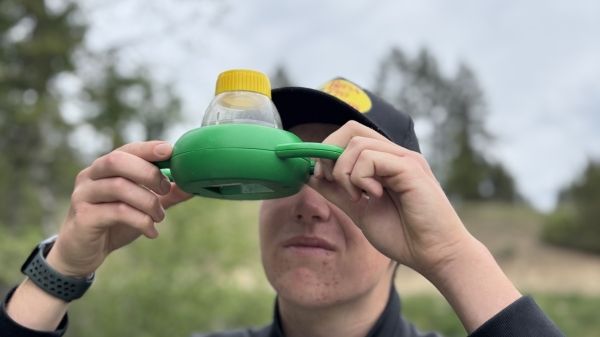
The program combines classroom learning with an immersive field experience. In class, students tackle challenging questions: Who should have priority when water is scarce? How can we balance human needs with ecosystem health? And how can water management adapt to the disruptions of a climate-impacted world? In the field, students gain hands-on experience measuring streamflow (water quantity) and conducting water-quality tests: dissolved oxygen, pH, nitrates, and phosphates, key indicators of watershed health.

Students reviewing the results of nitrate levels in their local creek to determine if the levels have an impact on the water quality and health. Photo credit: Living Lakes
“It was great to consider how us teenagers can contribute to keeping our water healthy and our ecosystem viable for all to thrive,” said grade 12 student Rae from Mt. Sentinel Secondary School, South Slocan.
By teaching scientific literacy, critical thinking, and collaborative problem-solving as interconnected skills, Watershed Matters empowers youth to become active stewards of their watersheds. Students take on new knowledge and a deeper appreciation of the role they can play in shaping a sustainable, water-secure future.
Designed as a scalable model, based on available funding, the Watershed Matters will expand to include additional classrooms in the 2025–26 school year. The goal is to reach even more students and new communities while continuing to inspire innovative solutions and local advocacy for water and ecosystem health.
Being selected as an E-STEM Awardee has been transformative for Living Lakes Canada, providing recognition, resources, and networks that have directly supported the growth of our Watershed Matters program. This award has enabled us to expand from a small pilot to a full program, allowing us to connect to more classrooms and communities, strengthen curriculum-aligned modules, and enhance hands-on experiential learning opportunities for youth. Beyond program expansion, the E-STEM designation has amplified our credibility with schools, partners, and funders, helping us engage a broader group of students while fostering the development of the next generation of environmental leaders and advocates.

Students review the potential source of pollution in the water mystery challenge. Photo credit: Living Lakes