Ripple Effect in Action: How Project WILD and ee360+ Partnerships Are Expanding Environmental Education




This blog post was written by Elena Takaki, director of leadership development and conservation education, of the Association of Fish and Wildlife Agencies.
At its core, the ee360+ initiative is built on a simple but powerful premise: meaningful change in environmental education happens through collaboration. Designed as a multi-year effort to strengthen the field, ee360+ connects educators, organizations, and agencies to advance environmental literacy and build a more sustainable future for all.
The Ripple Effect blog series highlights exactly what this collaboration looks like in practice with stories of partnership, innovation, and impact across a diverse network of leaders. For Project WILD, participation in ee360+ has amplified the program’s long-standing purpose of equipping educators with the tools, training, and confidence to teach about wildlife and conservation in meaningful, action-oriented ways.
A Network Built on Partnership
As one of the long-standing environmental education programs in North America, Project WILD brings to the collaboration an extensive experience in curriculum design and educator training. Through participation in ee360+, Project WILD has been able to expand its reach by connecting resources and training opportunities to broader networks, new audiences, and emerging priorities in the field.
Partnership, in this context, is more than simply coordination of activities but also co-creation. ee360+ partners routinely work across organizations to develop joint trainings, share resources, and align strategies. This approach was the impetus for Project WILD, Project WET, and Project Learning Tree to collaborate on multiple webinars, workshops, and conference events, thereby increasing efficiency, communication, and collaboration among each of our state networks.
One key example of this was in 2024 when Project WILD, Project WET, and Project Learning Tree held their first combined conference since the 1990’s! Over 250 people gathered in San Antonio, Texas, and everyone was very excited to get together.. We discussed challenges that all three programs face and worked hard at increasing collaboration between the three projects. Today, we see more combined education and outreach events, thanks to the community we’ve built over the past years through ee360+. This quote from one conference attendee sums up the excitement of this collaborative event:
“Overall, the conference was a success. People from all over the country/world came together to share their EE efforts and be inspired to do more and do better TOGETHER. Thank you!”
Scaling Impact Through Online Learning
Another example of the impact of ee360+ is Project WILD’s suite of online professional development courses. Developed and expanded through collaborative funding and support structures like ee360+, these courses represent a strategic shift toward scalability and increasing access for all.

WILD About Monarchs course. Photo credit: Project WILD
Project WILD’s online offerings—including Project WILD, Aquatic WILD, and Flying WILD—provide self-paced, standards-aligned training for formal and nonformal educators. These courses introduce participants to wildlife conservation concepts, ecological principles, and hands-on teaching strategies grounded in real-world applications.
Additional courses such as Climate & Wildlife, WILD About Bats, and WILD About Monarchs extend this learning into specialized content areas, helping educators address timely topics like climate adaptation, species conservation, and ecosystem dynamics.
What makes these courses particularly impactful is not just their content, but how they are delivered. By leveraging online platforms, Project WILD works alongside state coordinators, facilitators, and partner organizations to reach educators who may not have access to in-person workshops. This hybrid model reflects a broader ee360+ priority of mobilizing access to high-quality resources and networks so that geography is no longer a barrier to professional growth.
The Role of State and Local Partnerships
While ee360+ operates at a national scale, its success depends heavily on local implementation. Project WILD’s extensive network of state coordinators and facilitators plays a critical role in translating national resources into meaningful, place-based experiences. This approach ensures that educators are learning new content and skills while also engaging with a professional community that supports long-term practice and provides local connections. Additionally, state agencies and local organizations can tailor Project WILD materials to reflect regional ecosystems, conservation challenges, and education standards. The result is a model that balances consistency with flexibility—maintaining national quality while honoring local relevance.
Collaboration as a Catalyst for Innovation
The partnerships fostered through ee360+ consistently underscore one key insight: collaboration accelerates innovation. When organizations like Project WILD, Project Learning Tree, and Project WET come together under ee360+, they are able to design joint initiatives, co-host events, and share audiences in ways that would not be possible independently. This kind of partnership expands what environmental education can achieve. It enables cross-disciplinary learning, integrates new research into practice, and fosters a culture of continuous improvement. It also strengthens the professional identity of educators by connecting them to a broader movement committed to environmental literacy. By participating in a network that prioritizes collaboration, Project WILD contributes to—and benefits from—a shared vision of collective impact.

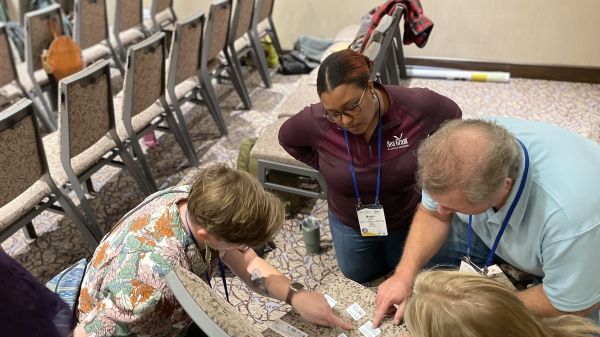
Project WILD, Project WET, and Project Learning Tree coordinators participate in a joint activity at the NAAEE Conference. Photo credit: Elena Takaki
Looking Ahead: Sustaining the Ripple
The success of ee360+ demonstrates that no single organization can meet the growing demand for environmental education alone. The environmental challenges facing our world are complex and interconnected. Addressing them requires an equally interconnected approach to education.
The ripple effect is real. Each educator trained, each partnership formed, and each course completed extends the reach of environmental education into new classrooms, communities, and conversations. And through ee360+, those ripples are not isolated, instead they are part of a larger wave of collaboration shaping the future of the field.
This eePRO blog series, Ripple Effect, highlights stories of collaboration and impact among partners in the ee360+ Leadership and Training Collaborative. ee360+ is an ambitious multi-year initiative that connects, trains, and promotes innovative leaders dedicated to using the power of education to create a more healthy and sustainable future for everyone, everywhere. Led by NAAEE, ee360+ is made possible through funding and support from U.S. EPA and twenty-five partner organizations representing universities and nonprofits across the country, as well as five federal agencies. Through this partnership, ee360+ brings together more than five decades of expertise to grow and strengthen the environmental education field.