From Salty Soil to Hope: How the 2025 Global E-STEM Award Transformed Our Coastal Community in Türkiye




E-STEM Stories: Branching Out shares stories of innovative E-STEM work from around the world. E-STEM engages students in meaningful, real-world environmental problem-solving that integrates science, technology, engineering, and math (STEM).
This post highlights Zeytinlibahçe Vocational and Technical Anatolian High School, a 2025 recipient of a Global E-STEM Award—Innovation Grant Winner. These awards, which support both new and established global E-STEM initiatives, are made possible by Pratt & Whitney and the North American Association for Environmental Education (NAAEE).
This blog post was written by Nurdan Özel, Turkish Language and Literature teacher, Scientix STEM ambassador and SERUVA project coordinator for Zeytinlibahçe Vocational and Technical Anatolian High School.
Coastal agricultural communities around the Mediterranean face a silent yet devastating crisis: soil salinization. In Kazanlı, Mersin—a coastal district in southern Türkiye known for its rich agricultural heritage—rising groundwater levels, uncontrolled irrigation, and shifting climate patterns have gradually turned fertile lands into high-salinity zones. For local farming families, declining crop yields threaten not just their immediate livelihoods, but the ecological balance and the long-term future of sustainable agriculture in the region.
As a Turkish Language and Literature teacher, Scientix STEM Ambassador, and passionate advocate for interdisciplinary education, I asked a fundamental question:
“How can we empower our students to use Science, Technology, Engineering, and Mathematics (STEM) to solve an urgent environmental crisis happening right in their own backyards?”
The answer led to the birth of SERUVA: From Salty Soil to Hope—a student-led, community-driven movement that bridges environmental action, smart technology, and an open schooling approach.
A Life-Changing Catalyst: The 2025 Global E-STEM Award
Great ideas require support to transition from classroom concepts to field-tested solutions. Winning the 2025 Global E-STEM Award—presented by the North American Association for Environmental Education (NAAEE) in partnership with Pratt & Whitney—marked a historic milestone for our school. Zeytinlibahçe Trade Vocational and Technical Anadolu High School, is the first educational institution in Türkiye to receive this prestigious international recognition.

A student team explores the 2025 Global E-STEM Award winner announcement on the NAAEE portal. Photo credit: Nurdan Özel
This award extended far beyond financial support; it instilled in our students the confidence to see themselves as global changemakers. With this grant, we transformed our vision into a fully equipped, hands-on E-STEM learning ecosystem, officially launching the SERUVA Project.
Inside SERUVA: Smart Technology Meets Environmental Literacy

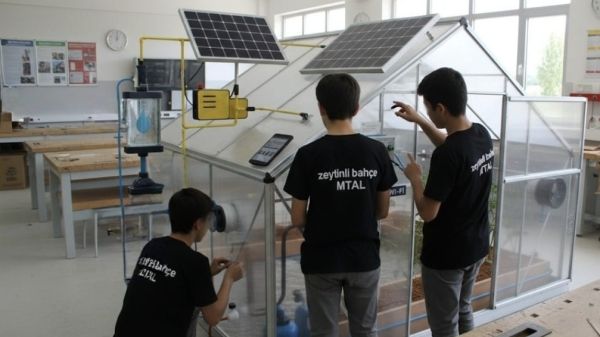
At the heart of the SERUVA project is a modular, solar-powered prototype designed specifically for high-salinity coastal agricultural lands. Built and monitored by our secondary school students working side-by-side with local farmers, the system integrates four core components:
- Multi-Stage Filtration and Water Purification: Purifies brackish groundwater to ensure safe irrigation without imposing additional salt loads on fragile soils.
- Solar Power Units: Enables the entire system to operate off-grid using clean, renewable energy.
- IoT Sensor Networks and Automated Drip Irrigation: Delivers precise amounts of water directly to root zones via soil electrical conductivity (EC) and moisture sensors, preventing water waste and soil degradation.
- Mobile Monitoring Interface: An accessible mobile app developed by students that translates complex sensor metrics into daily, actionable insights for local farmers.
What makes SERUVA truly unique is its integration of the LOESS (Literacy in Open Educational Resources for Soil Sustainability) educational framework. We do not stop at manufacturing technical hardware; we actively cultivate environmental awareness in the community. Through open schooling workshops, our students deliver hands-on training to local farmers on mycorrhizal networks, soil health, organic matter cycles, and sustainable water management.

Interdisciplinary Impact: Bridging STEM and Human Values
Blending literature with STEM reinforces my core belief that environmental literacy is deeply linked to empathy and human connection. Throughout the SERUVA process, our students did not merely write code or build circuits; they listened to the real-life stories of multi-generational farming families, analyzed regional socioeconomic challenges, and designed human-centered solutions.


Additionally, a core team of 20 students, alongside teachers, agricultural workers, and community members, actively participated in field measurements and prototype testing. In doing so, our students gained essential 21st-century skills—such as 3D CAD modeling, embedded system programming, public speaking, and localized environmental advocacy—directly in the field. The project went beyond simply building STEM skills to developing environmental leaders.


Looking Ahead: Building a Model for Sustainable Futures
Winning the 2025 NAAEE Global E-STEM Award proved that when young people are trusted with real-world problems, their capacity for innovation is boundless. Today, SERUVA continues to grow. We are embedding the project into our school's standard curriculum, expanding our smart greenhouse automation testing, and sharing our findings across international educational networks (including COST Actions and Scientix).
To the NAAEE community, Pratt & Whitney, and environmental educators worldwide: thank you for investing in youth-led climate solutions. From a small coastal community in Türkiye, we are showing the world that even from salty soil, hope and innovation can bloom.
Join eePRO today and be a part of the conversation!
Comment and connect with fellow professionals in environmental education. Join eePRO >