Celebrating a Love of Reading—Outdoors
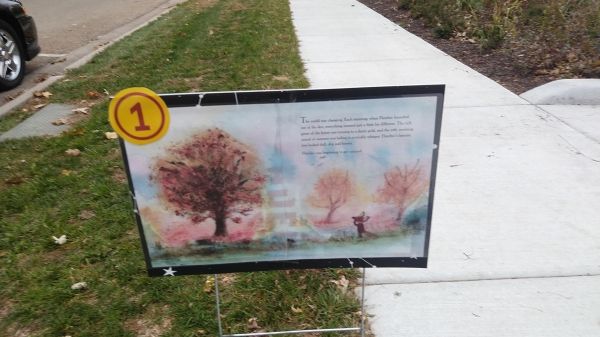




Editor's Note: This blog post was written by Heather Phelps, a community contributor, for the K–12 EE eePRO Group.
As a librarian, I love connecting children and their families with books. In the fall of 2020, in the midst of Covid, I found myself confronting the question of how to serve a community who couldn’t gather in the library for storytimes, summer reading programs, or any of the other traditional library activities. I needed a way to engage families in reading activities while keeping them far enough away from others for safety—better yet, outside the library building altogether. One of the solutions I hit upon was StoryWalks®.
What Is a StoryWalk?
StoryWalk® was created in 2007 by Anne Ferguson of Montpelier, Vermont, in collaboration with former Kellogg-Hubbard Library staff member Rachel Senechal. Since then, StoryWalks have been put up around the country and internationally.
The basic StoryWalk concept takes the pages of a book and places them in order along a path. People walk from page to page, until they read through the entire book. In my case, my library didn’t have much outdoor space, and we couldn’t get agreement from a local park, so I asked businesses up and down the street my library was on if they’d be willing to have a page in their front window. Everyone immediately agreed, happy to support a library program. Families started at the library, then walked down the street and back again on the other side, with the final page bringing them back to the library. In parks or along trails, on the other hand, the pages are instead often fastened to 4-foot posts stuck in the ground. The fanciest ones I’ve seen have been in permanent boxes, mounted alongside a trail as if they were signboards. With an openable case, the book page inside can be swapped out as often as desired.

How Does One Create a StoryWalk?
Creating a StoryWalk is simple—the only required element is two copies of the book being used (the second copy is so that the back side of each page will also be included). To avoid copyright issues, the pages on display shouldn’t be photocopied or otherwise altered, but instead should be cut from a purchased copy of the book. I took my books to a local print shop to cut the bindings off neatly. Then I glued one or two pages (depending on their size) to a piece of oversized cardstock or construction paper and laminated them. To provide additional support to readers, on the edges of the cardstock I’d also add a page number, an arrow in the direction of the next page, and a note that this was created by the library, in case someone stumbled on the walk halfway through and wanted more information.
Sometimes I’d also add a question to spark discussions and get readers to think more deeply about the story. For an environmentally themed StoryWalk, that would also be a great opportunity to challenge readers to find elements from the story in the world around them, or to connect to previous experiences in nature.

Finally, the creators of StoryWalk ask that everyone who wishes to create their own StoryWalk follow these guidelines:
Please use the StoryWalk® trademark and include the following statement in all promotion of the project:
“The StoryWalk® Project was created by Anne Ferguson and developed in collaboration with the Kellogg-Hubbard Library in Montpelier Vermont. Storywalk® is a registered service mark owned by the Kellogg-Hubbard Library.”
Storywalks must be educational, noncommercial projects used to promote early literacy, physical activity, and family time together in nature.
(From: https://kellogghubbard.org/programs-events/storywalk/)
Why Develop a StoryWalk?
StoryWalks inspire families to celebrate a love of reading outdoors, making them a valuable tool in environmental education. The StoryWalk Project outlines three benefits on their website:
StoryWalk® provides early literacy opportunities to young children. Sharing the reading of a StoryWalk book stimulates and fosters the development of strong listening and speaking skills. StoryWalk also helps to build a child’s vocabulary which is important to thinking and learning. Developing early literacy skills leads to better preparation for school.
StoryWalk® provides a teaching moment for a child’s first teacher—their family. Children and their families can read the book together then discuss the text, illustrations and meaning of a great book. Many StoryWalk books have a theme: kindness, anyone can make a difference in someone’s life, a love for nature, accepting differences, and more.
StoryWalk® provides a wonderful avenue for outreach and collaboration. StoryWalk is a tool to bring the library out to the community with the goal of increasing visibility of the library. Some people may experience StoryWalk at a school or park and never walk into the library. StoryWalk may be the gateway for people to come to the library.


StoryWalks can also be used in group settings—such as at nature centers, camps, early learning centers or schools. Watch this video from the Annapolis Valley Regional library in Canada to see teachers and students moving together through the walk. StoryWalks can be a great alternate activity on a playground or be used to bring learning to other areas on the schoolyard.
Now that people are willing to congregate inside again, StoryWalks are no longer crucial for serving families who feel unsafe indoors. However, we have come back around to a time when people are once again spending all their time inside, and StoryWalks can provide that impetus to get back outside and spend time appreciating nature.
While the books I used tended more towards standard children’s favorites like Mother Bruce and How to Make an Apple Pie and See the World, a StoryWalk with focus on environmental education could use a book like My Forest is Green, We are Water Protectors, or The Planet We Call Home to encourage families to think deeper about the world around them on the walk and the bigger picture of caring for the environment as a whole. If you need some inspiration for children’s titles, librarians in King County, Washington put together this list of books focused on animals, native plants, gardening, and play to use in their StoryWalk a local arboretum and the librarians behind Goodreads also provide a curated list of StoryWalk ideas.
If you have a StoryWalk, are thinking about creating one, or have engaged with one, please share it in the comments below!