From Belonging to Environmental Action: Shaping Green Bridges Through the Leadership Institute






In the CEE-Change, Together blog series, NAAEE shares narratives from the CEE-Change Fellows as they implement their community action projects and work to strengthen environmental education and civic engagement capabilities, all supporting the mission of cleaner air, land, and water. Join us on their journey! The Civics and Environmental Education (CEE) Change Fellowship is NAAEE’s initiative to support leadership and innovation in civics and environmental education in North America and beyond.
The 2025 U.S.-based CEE-Change Fellowship Program is supported by generous funding from ee360+, the Cedar Tree Foundation, the Sam and Mary Lawrence Foundation, and the Weeden Foundation. The 2025 International CEE-Change Fellowship Program is a partnership between NAAEE and the Global Environmental Education Partnership (GEEP).
Walking Into the CEE-Change Leadership Institute with Intention
When I first arrived in the United States in September 2024, I carried more uncertainty than confidence. I could not speak English well, and every sentence felt heavy with doubt. The English Language Institute (ELI) became the place where that uncertainty slowly transformed. For more than seventy years, the ELI has welcomed international students from around the world, helping them strengthen their English skills and guiding them as they navigate American culture. I became one of those students. Through patient teachers, supportive classmates, and a community that believed in my potential, I found my voice.
That experience planted the first seed of Green Bridges, a community project designed to support students at the University of Florida’s ELI by fostering leadership skills while engaging in environmental action. Through this initiative, I wanted other international students to feel the same sense of belonging that I had discovered. Moreover, I wanted them to know that their stories mattered, that their cultures were strengths, and that they could contribute meaningfully to their host community. I saw environmental action as a powerful way to bring those stories and strengths together, giving students a shared purpose that connected their identities to caring for the places around them.

First day of the English Language Institute at the University of Florida in Fall 2024. Photo credit: Christ Mane Belizaire
By the time I arrived at the CEE-Change Leadership Institute in August 2025, Green Bridges was already taking shape as a community initiative designed to support international students in building environmental awareness, leadership skills, and civic responsibility. I believed deeply in the purpose of the project and in the students who would participate in it. However, my experience at the Leadership Institute helped me strengthen and refine my vision for Green Bridges, especially in how to design the project in a way that fosters participation, shared leadership, and meaningful environmental engagement.
Yet I also carried an unspoken intention. I wanted to understand how to lead this work in a way that truly honored the diverse cultures, experiences, and hopes of the students who would join Green Bridges. I wanted to ensure that the project was not only well designed, but also deeply rooted in respect, belonging, and shared purpose. I remember asking myself quietly: how can I create a space where every student feels seen and valued?
The Leadership Institute was the place where that intention found clarity and transformed my understanding of belonging into intentional, action-oriented environmental leadership within Green Bridges.
Seeing Cultural Exchange as a Pathway to Civic Belonging

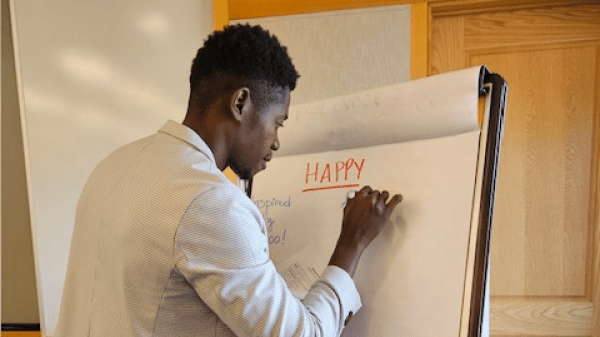
Connecting with Teresa Cole during an ice-breaker activity at the CEE-Change Leadership Institute. Photo credit: Danny Woolums, CEE-Change Fellow 2021
Throughout the Institute, we examined civic engagement, community resilience, trust, wellbeing, and the many ways that environmental education intersects with community life. One of the most meaningful insights from the Institute was the recognition that environmental education and civic engagement are deeply connected. For international students, participating in environmental activities is not only a learning experience, it is also a way to feel part of the community.
This insight changed how I designed and facilitated Green Bridges. I began to see each activity not just as an environmental action, but as an opportunity for students to build civic identity, share cultural perspectives, and feel a sense of belonging in Gainesville.
The Institute helped me understand that cultural exchange is not an “extra” component of the project; it is a core pathway to leadership and civic participation. As a result, I intentionally redesigned Green Bridges activities to include community-based environmental actions such as campus clean-up events and a cultural fair where students could share their backgrounds, connect their experiences to environmental issues, and build stronger relationships within the community. Green Bridges continues to evolve, but it now does so with a better understanding of how environmental action can foster belonging and a deeper sense of community.