Empowering E-STEM Education for Students with Disabilities in Indonesia



E-STEM Stories: Branching Out shares stories of innovative E-STEM work from around the world. E-STEM engages students in meaningful, real-world environmental problem-solving that integrates science, technology, engineering, and math (STEM).
This post highlights the ASA Foundation, a 2024 recipient of a Global E-STEM Award. These awards, which support both new and established global E-STEM initiatives, are made possible by Pratt & Whitney and the North American Association for Environmental Education (NAAEE).
This blog post was written by Lee Hawkins, founder of the ASA Foundation.
At ASA Foundation, we believe that every learner, regardless of ability, deserves the opportunity to explore the world of science, technology, engineering, and mathematics (E-STEM). With the support of Pratt & Whitney and the North American Association for Environmental Education (NAAEE), our E-STEM for Disabilities for Education Development project in Indonesia is working to make this vision a reality. The initiative focuses on expanding access to E-STEM learning by providing teachers with the tools, confidence, and collaborative methodologies needed to create meaningful, engaging learning experiences for students with disabilities.
The first phase of the program has already achieved an inspiring milestone. From an initial pool of 104 applicants, we selected 50 dedicated teachers (32 female and 18 male) who demonstrated a strong passion for education for all. Among them are three educators with disabilities, including a female blind teacher, a male blind teacher, and a female teacher who is non-verbal. Their leadership, combined with their lived experiences, adds powerful representation to the program. This reflects our commitment to fostering fairness and access at every level of the initiative.

The project implemented weekly E-STEM school classes for male and female students with disabilities. Photo credit: ASA Foundation
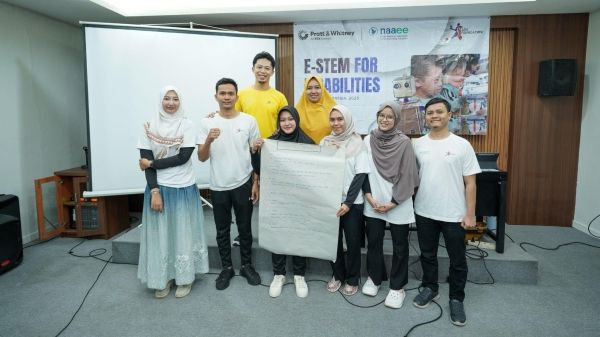
These educators are now participating in a comprehensive series of Training of Trainer workshops hosted by the ASA Foundation, with support from Pratt & Whitney and NAAEE, designed to equip them with the skills and knowledge needed to implement collaborative E-STEM approaches. These workshops are complemented by weekly mentoring sessions and monitoring and evaluation forums, providing continuous support and ensuring that the teachers are empowered and well-equipped to meet the varied needs of their students. Additionally, school visits are conducted by the ASA Foundation team to further reinforce the training and offer hands-on guidance as teachers apply their learning in real classroom settings.
Through this training, mentoring, and school-based support, the teachers are becoming champions of STEM education for all. Many had minimal exposure to science, technology, engineering, mathematics, and environmental education prior to the program, but the training sparked a new level of curiosity, motivation, and eagerness to explore these fields further. One especially inspiring story comes from Mr. Heru, a blind male teacher selected for the program. Despite his visual impairment, Mr. Heru has demonstrated outstanding commitment to advancing STEM education for students with disabilities in Jakarta. His participation in our training has empowered him to integrate accessible digital tools into his lessons—technology that allows him to navigate teaching materials more independently and create engaging, hands-on learning opportunities for his students. His perseverance and innovation continue to inspire both his students and fellow teachers, showing what is possible when accessibility and determination come together.
Teachers report that their students with disabilities are also showing greater interest and participation in hands-on E-STEM activities, signaling a growing receptiveness among learners who have traditionally been underserved in these subjects. On average, each of the 50 teachers is reaching about 100 students, directly impacting the lives of 5,067 students with disabilities, including 2,255 male and 2,812 female learners.

The program's impact included 1,400 E-STEM classes delivered. Photo credit: ASA Foundation
This early impact represents more than just numbers; it reflects the transformation of classrooms into more collaborative spaces, where barriers are being broken down and students are gaining confidence in their ability to fully participate in STEM learning. Through this program, we are not only expanding educational opportunities but also promoting gender equality and opening pathways for students with disabilities to pursue futures in STEM across Indonesia.

The E-STEM for Disabilities program trained 50 teachers and educated an impressive total of 5,067 students. Photo credit: ASA Foundation