Birds, Energy, and a Significant Opportunity in Environmental Education




Editor's note: This post was written by Martin Ogle, a community contributor, and highlights a program they are involved with. This program is not affiliated with or run by NAAEE.
Birds may be one of the most powerful—and overlooked—ways to teach about energy!
From the nonstop migration of Blackpoll Warblers to the heat-saving design of birds’ legs, birds are living examples of how energy flows, transforms, and sustains life. At the same time, the ways we produce and use energy are among the greatest threats that birds face. This connection opens a door: by linking energy to something people already care deeply about, environmental educators can make energy visible, tangible, and engaging in entirely new ways.
And that matters, because energy is the most cross-cutting issue of our time. The choices we make about energy shape climate, biodiversity, economies, and communities. Yet energy remains underrepresented in environmental education—often treated as technical, abstract, or separate from the natural world. In reality, it is foundational to understanding both human and ecological systems.
There are many opportunities to reconnecting energy education with environmental education!
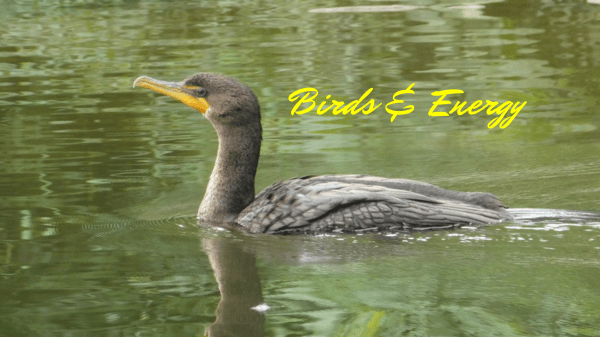
One promising pathway is “Birds & Energy,” a program designed to bring energy back into environmental learning through a familiar and compelling lens. The program explores bird adaptations—from extraordinary migrations to physiological strategies like countercurrent heat exchange—and connects them to core energy concepts such as photosynthesis, energy transformation, and heat loss. It also examines how different human energy technologies affect birds, and what can be done to reduce those impacts.
Just as important, the program is designed to be flexible and engaging. It can take the form of a talk, an interactive demonstration (including hands-on elements like an “energy bike”), a guided walk, or a combination of these. The goal is not just to convey information, but to spark curiosity and conversation—about energy, about systems, and about our role within them.
What has been most striking, however, is not just the content of the program, but where it leads.
Through partnerships with Audubon chapters, “Birds & Energy” has begun reaching diverse audiences across the country. With more than 450 chapters nationwide, Audubon provides a ready-made network of communities already invested in birds and conservation. Presentations to date have taken place in multiple states, with more scheduled—demonstrating both interest and scalability.
More importantly, the potential for these events to act as catalysts is starting to come into focus.
In southwestern Colorado, a program hosted by the Weminuche Audubon Society brought together not only bird enthusiasts, but also representatives from the local electric utility, a school district, a faith community, and regional nonprofits. The result was not just a well-attended event, but the beginning of a broader community conversation about energy. Participants will be reconvened by the Mountain Studies Institute to explore local energy awareness and opportunities more deeply.
In Austin, Texas, a “Birds & Energy” event hosted by the Travis Audubon Society this September is being intentionally positioned as a lead-in and introduction to the annual conference of the American Solar Energy Society.
These examples point to a larger opportunity. Environmental education organizations are uniquely positioned to do more than deliver programs—they can convene communities. By partnering with local Audubon chapters or similar groups, they can use engaging entry points like birds to draw people in, and then expand the conversation to include energy literacy, local impacts, and collective action.
This approach works because it meets people where they are. Birds are familiar. They inspire wonder. They provide a non-polarizing way into conversations that can otherwise feel technical or contentious. From there, energy becomes not an abstract system, but something observable, relatable, and relevant.
For organizations looking to deepen their impact, the implications are clear. Hosting or co-hosting a “Birds & Energy” program is one step. Using it as a springboard to reconvene participants—bringing together educators, energy professionals, community leaders, and citizens—is another. Aligning these efforts with existing events, such as conferences or community gatherings, can amplify reach even further.
The need is urgent; the pathway is practical and easy to set up!
Environmental education has always been about helping people understand their relationship with the natural world. Today, that relationship is profoundly shaped by energy. By bringing energy back into the center of environmental education—and by doing so through engaging, accessible entry points—we can equip communities with the understanding they need to navigate one of the defining challenges of our time.
The question is no longer whether we should integrate energy into environmental education. It is how quickly—and how effectively—we can do it.
“Birds & Energy” offers one proven way forward. To find out more, or to set up a “Birds & Energy” program through your organization or in conjunction with a local Audubon Chapter, contact Martin Ogle martinogle@hotmail.com or 720-612-0506