ALOHA EE: Building Relationships Before Building Programs



In the CEE-Change, Together blog series, NAAEE shares narratives from the CEE-Change Fellows as they implement their community action projects and work to strengthen environmental education and civic engagement capabilities, all supporting the mission of cleaner air, land, and water. Join us on their journey! The Civics and Environmental Education (CEE) Change Fellowship is NAAEE’s initiative to support leadership and innovation in civics and environmental education in North America and beyond.
The 2025 U.S.-based CEE-Change Fellowship Program is supported by generous funding from ee360+, the Cedar Tree Foundation, the Sam and Mary Lawrence Foundation, and the Weeden Foundation. The 2025 International CEE-Change Fellowship Program is a partnership between NAAEE and the Global Environmental Education Partnership (GEEP).
When people think about expanding an environmental education program into a new place, they often imagine curriculum, workshops, and implementation plans. My CEE-Change Community Action Project has reminded me that meaningful change starts somewhere much simpler: with listening.
Hawaiʻi is unlike anywhere else in the United States. Its history, cultures, communities, and relationships with the land require approaches that are rooted in respect, humility, and trust. While Project Learning Tree (PLT) has successfully supported environmental educators across the country for more than 50 years, there is currently no organization coordinating PLT programming in Hawaiʻi. Rather than viewing this as simply a programmatic gap, I saw it as an opportunity to first understand the existing environmental education landscape and learn from the people already doing this work.

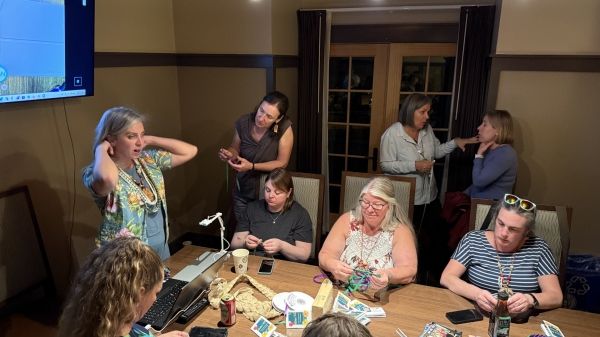
Bringing lei making to Nebraska, a conversation in cultural exchange. Photo Credit: Renee Strnad
My project, ALOHA EE: Increasing Impact Across Hawaiʻi, has two interconnected goals. The first is to identify a sustainable local organization that could eventually serve as Hawaiʻi's Project Learning Tree delivery partner.

The second—and perhaps more important—is to strengthen relationships among environmental education providers by rebuilding connections across organizations that often work toward similar goals but have limited opportunities to collaborate.
The project began with research. I conducted a landscape analysis to identify organizations whose missions, capacity, and community connections align with PLT's model. That work highlighted several promising partners across higher education, nonprofit, and government sectors. Rather than assuming any one organization would be the right fit, the analysis created a starting point for conversations grounded in shared values and mutual benefit.
Aloha EE: Increasing Impact Across Hawai’I is the title of Jackie’s CEE-Change project. This is the cover of her zine (8 page mini-magazine) that was shared at the annual PLT Conference, at Arbor Day Farm’s Lied Lodge in Nebraska City, Nebraska, March 23–23, 2026. Photo credit: Langx Design
Research, however, only tells part of the story. The heart of this project has been creating opportunities to "talk story," a uniquely Hawaiian tradition of building relationships through genuine conversation. These listening sessions are not designed to promote a program or recruit partners. Instead, they create space for environmental educators to share their experiences, identify community needs, discuss challenges, and explore opportunities for collaboration. In many ways, these conversations are the project.

Paving the way for PLT in Hawai’i. Photo credit: Sarah Davis
One lesson that has become increasingly clear is that trust cannot be rushed. Effective partnerships are not built through presentations or proposals; they grow through consistent presence, careful listening, and a willingness to understand local priorities before offering solutions. As someone representing a national organization, I've learned the importance of approaching every conversation with curiosity rather than certainty.

Meeting communities where they are, learning kapa to build trust. Photo credit: Jaclyn Stallard
This relationship-centered approach has also led to unexpected collaborations. Through the CEE-Change Fellowship, I connected with fellow Hawaiʻi-based Fellow Denby Freeland of Hawaiʻi Land Trust. Although our projects focus on different islands and different objectives, we quickly discovered opportunities to support one another's work. Together, we've explored ways to adapt Project Learning Tree activities for local restoration efforts and are planning community engagement experiences that combine environmental learning with meaningful civic action.
One example is a planned Civic Engagement Workday centered around making Genki Balls for the Ala Wai Canal watershed. Through this type of activity, participants don't simply learn about water quality—they actively contribute to restoring their local environment while building relationships with fellow community members. This reflects one of the core ideas behind the CEE-Change Fellowship:
Civic engagement becomes most meaningful when people can see themselves as active participants in caring for the places they call home.


Genki Balls help support the restoration of the Ala Wai Canal by promoting natural bioremediation and inspiring community stewardship of one of Waikīkī's most important waterways. Photo credit: Jaclyn Stallard
The initial idea was to plan multiple Civic Engagement Workdays, but as more conversations transpired and active listening practiced, I found the need to pivot. I heard an overwhelming need for two things 1) local Hawaiian adaptations to PLT lessons and 2) the need to support Hawaiian educators with ʻāina-based education pedagogy. To support these needs, I identified, tested, and designed eight PLT activity adaptations for Hawaiian educators to help implement ʻāina-based education here at home.
Denby Freeland, fellow CEE-Change Fellow and Director of ʻĀina Education and Community Impact at Hawaiʻi Land Trust, comments: “With the current emphasis on ʻāina based education, a lot of teachers are very intimidated. Your Hawaiian PLT adaptations could be great tools to help some teachers to get the ball rolling. They are really great resources. Next year, I would like to offer them to my teachers!”
As the project has evolved, my definition of success has evolved with it. While securing a future PLT delivery partner remains an important long-term goal, success is no longer measured solely by whether one organization agrees to host a program. Instead, I now see success in stronger relationships, new collaborations, and growing momentum among educators who care deeply about Hawaiʻi's future.
ʻĀina-based education is a place-based approach to learning that uses the local land, waters, history, and culture as the classroom. In Hawaiʻi, the word ʻāina means "that which feeds," reflecting the understanding that people and the land care for one another. Rather than simply learning about nature, students learn with and from the places and communities around them.
The CEE-Change Fellowship challenged me to think beyond delivering educational resources and instead consider how to strengthen the networks that make those resources meaningful. By leading with listening, honoring local knowledge, and investing in authentic relationships, I hope ALOHA EE contributes not only to the return of Project Learning Tree to Hawaiʻi, but also to a stronger, more connected environmental education community that is uniquely shaped by the people and places it serves.
Sometimes the most important outcome of a community action project isn't the program you launch—it's the trust you build along the way.