What One Season of Learning Can Cultivate




E-STEM Stories: Branching Out shares stories of innovative E-STEM work from around the world. E-STEM engages students in meaningful, real-world environmental problem-solving that integrates science, technology, engineering, and math (STEM).
This post highlights Action for Community Resilience Group, a 2025 recipient of a Global E-STEM Award. These awards, which support both new and established global E-STEM initiatives, are made possible by Pratt & Whitney and the North American Association for Environmental Education (NAAEE).
This blog post was written by Allieu Christopher Moiwa, project lead at the Agroforestry Learning Lab in Njala University, Action for Community Resilience Group (ACRG), Sierra Leone.
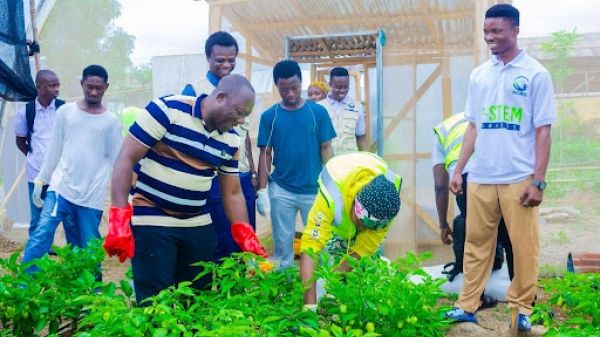
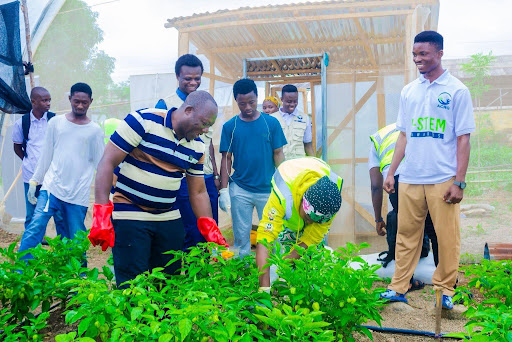
On June 20, 2026, student groups at the Agroforestry Learning Lab at Njala University harvested the crops they had raised from seed trays. Groups from the University Secondary School and the Experimental School worked through their own beds, checking what each had grown against the records they had kept since planting. The group lead for the Experimental School went straight to a bed of peppers. Weeks earlier, during a hands-on soil and farming session, she had shown her group how to transplant seedlings into the prepared beds, and now she wanted to be the one to harvest it. Afterwards, her group carried out the first tree seedling it had nursed from seeds and planted it in the agroforestry plot beside the greenhouse. As the Lab's first growing cycle drew to a close, we stopped to reflect on the journey that brought us to this point.
The Need for an Agroforestry Lab
Njala University sits in Kori Chiefdom, where farming depends on soil that has been depleted through dry-season fires and slash-and-burn clearing. Burned land loses ground cover allowing topsoil to wash away when the rain comes. Degraded soil holds less water and grows less food, and the effects reach family nutrition and health.
As a youth-led nonprofit organization focused on sustainable agriculture and youth engagement, Action for Community Resilience Group (ACRG) recognized the need for community action to address this issue. With support from the 2025 Global E-STEM Awards Excellence Prize, ACRG designed a youth-centered environmental STEM learning initiative that integrates agroforestry demonstration, greenhouse learning, and digital environmental monitoring so young people could gain the knowledge and skills needed to address the environmental issues facing their community.
Designing the Solar Smart Agroforestry Learning Lab
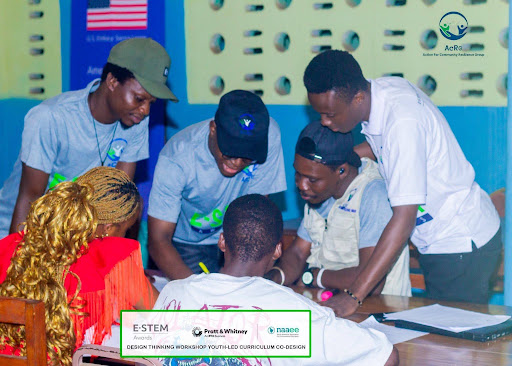
The planning for the Lab began in January 2026 at the American Corner in Bo City. Young environmental advocates, agro-farmers, and students spent a design thinking workshop reviewing our draft curriculum against their own field experience. Their changes pushed it toward hands-on work tied to real farming problems. The revised draft then went to Njala University's Directorate of Research and Development for academic validation. Faculty from Agricultural Engineering, Forestry, Biological Sciences, Physics, Chemistry, and Mathematics provided technical guidance to ensure the learning modules were scientifically sound and appropriate for participating students.
ACRG designed and built a solar powered greenhouse at Njala University to serve as a hands-on STEM learning laboratory for the program. The facility included a solar-powered irrigation system to ensure reliable energy supply for irrigation and greenhouse operations. A 15,000-litre water storage tank connected to a borehole system provided consistent water supply for nursery and greenhouse activities.
The Program
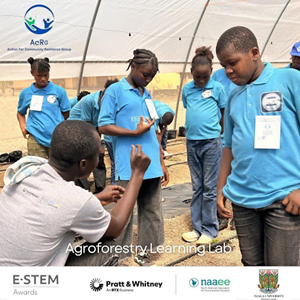
The first sessions began on February 17, 2026. Within the greenhouse, students established a plant nursery of approximately 2,500 seedlings, which were monitored and maintained as part of practical learning activities. These seedlings will later be transplanted into designated agroforestry field plots during the next phase of the project. Students also participated in hands-on compost preparation and soil fertility improvement activities, experimenting with different compost formulas to understand how organic materials improve soil nutrients and plant growth. Environmental monitoring concepts were introduced through a digital STEM dashboard integrated into greenhouse learning sessions, helping participants understand how environmental data can support agricultural decision-making. Students in the Junior Track (ages 11–16) and Senior Track (ages 17–22) rotate monthly through five roles: Greenhouse Lead, Compost Lead, Field Lead, Data and Records Lead, and Tools and Safety Lead. Young women held lead roles across the groups.
Two Plots, Two Results
To determine the benefits of smart agroforestry practices, students managed two comparison sites. Outside the greenhouse, they planted seeds in the conventional way, without testing the soil. Inside, they managed beds using data. They tracked soil nitrogen, phosphorus and potassium (NPK), moisture, pH and sunlight exposure through the sensors, and recorded growth rates, pest infestation, and changes in soil condition by hand. We pilot-tested the Smart Greenhouse Dashboard, which gives real-time readings from sensors in the greenhouse beds.
Students acted on what the readings showed. When nutrient levels dropped, they added organic matter and compost. When moisture fell, they adjusted the watering. When pests appeared, they treated the plants early instead of waiting for visible damage. They also adjusted sunlight exposure bed by bed.
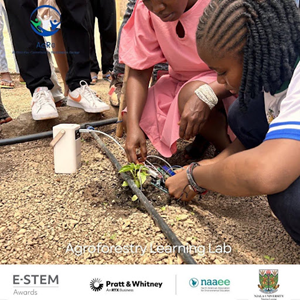
seedling to feed moisture and nutrient readings
to the Smart Greenhouse Dashboard.
Photo credit: ACRG
By harvest, the greenhouse beds had outperformed the outdoor plots in both growth and yield. The Experimental School's group lead described what it meant to see her team's work to actively manage crops yield measurable results.
“We didn’t guess. We checked the soil, we fed it, we watched the moisture and the pests, and the harvest came out the way the data said it would. Now I know a good harvest is something you can plan.”
Through this work, students saw how the soil they had fed with compost changed over the season. As part of the program students also learned basic coding and data analysis.
What the Elders Knew
When students shared their results with farmers and elders from Mokondeh, the conversation turned to how farming decisions used to be made. The elders explained that, in the past, a good harvest depended on close observation of the land and the seasons, on reading the stars to judge planting time, and on prayer. Some of their observations about land and timing matched what students had found. By merging traditional knowledge with scientific monitoring including soil testing, students learned how to identify why some plots struggled and how to correct them before harvest.
Trees for Burned Land
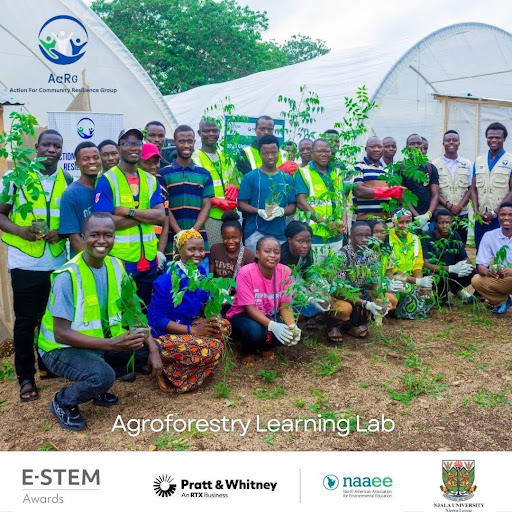
During and after the harvest season, students gave more than 2,000 tree seedlings from the Lab nursery to farmers who practice slash-and-burn clearing, for planting on their own farmland. Students and farmers also planted seedlings in communities across Kori Chiefdom affected by wildfires.
Alongside the planting, young people led community sensitization sessions on environmental stewardship. They told farmers that their generation will live longest with the consequences of how the land is treated now, and that this gives them reason to lead its recovery.
Reach and Partners
The Lab set out to engage 250 young people aged 11 to 22, at least 60% of them girls and young women, and to reach 500 community members through demonstrations on 80 smallholder farms. By July 2026, the Lab had exceeded these targets by 12%.
The Lab is hosted by the Department of Agricultural Engineering at Njala University, a leading institution for agricultural and environmental education in Sierra Leone. The University's Directorate of Research and Development provides advisory and technical guidance under a five-year Memorandum of Understanding with ACRG. ACRG's Project Lead, Allieu Christopher Moiwa, came to environmental work from community health, and the Lab was designed with One Health in mind: the health of people, animals and the environment is connected.
What the Prize Changed
The 2025 Global E-STEM Awards Excellence Prize let us expand the Lab. We added the soil sensors and the Smart Greenhouse Dashboard, so students could test the soil instead of guessing, and we built more of each session around hands-on work. The prize also let us take the Lab to farmers and to fire-affected communities across Kori Chiefdom, and it brought our work wider recognition.
Recognition
On September 28, 2026, I received the Freedom 250 Alumni Impact Award from the Sierra Leone United States Alumni Association and the U.S. Embassy Freetown for my work in environmental education and youth leadership in Sierra Leone. Much of that work is with the Lab, and NAAEE's support made it possible. ACRG shares the award with the students, farmers, partners, and mentors behind it.
We thank NAAEE for that support and for the chance to tell this story here, and Pratt & Whitney for funding the prize.

Allieu Christopher Moiwa receives the Freedom 250 Alumni Impact Award at the U.S. Embassy Freetown, September 28, 2026.