Listening in the Desert: How the CEE-Change Leadership Institute Reshaped My Community Action Project



In the CEE-Change, Together blog series, NAAEE shares narratives from the CEE-Change Fellows as they implement their community action projects and work to strengthen environmental education and civic engagement capabilities, all supporting the mission of cleaner air, land, and water. Join us on their journey! The Civics and Environmental Education (CEE) Change Fellowship is NAAEE’s initiative to support leadership and innovation in civics and environmental education in North America and beyond.
The 2025 U.S.-based CEE-Change Fellowship Program is supported by generous funding from ee360+, the Cedar Tree Foundation, the Sam and Mary Lawrence Foundation, and the Weeden Foundation. The 2025 International CEE-Change Fellowship Program is a partnership between NAAEE and the Global Environmental Education Partnership (GEEP).
Arriving with a Question
In August, I stepped into the CEE-Change four-day Leadership Institute carrying a project I cared deeply about and a quiet question I had not yet fully named.
Was I truly leading this work in a way that honored the community it was meant to serve?
At the time, my Community Action Project, Desert Futures: Voices of the Desert, was already in motion. It was designed as an intergenerational storytelling and nature-connection initiative rooted in the Sonoran Desert. The goal was to bring together university students, elders, educators, and youth to explore climate change, biodiversity, and civic responsibility through shared observation and storytelling. I believed in its premise. I believed in its participants.
What I did not yet fully understand was how profoundly the way I led the project would shape its impact.
The August Leadership Institute changed that.
Slowing Down to Truly Listen
During the Institute, we were invited to consider leadership not as authority or direction, but as a relationship. That framing stayed with me. I realized that while Desert Futures centered listening as a value, I had not fully examined how I practiced listening as a leader. I was facilitating conversations. I was designing sessions. I was coordinating logistics. But was I truly creating space for shared ownership?
The Institute pushed me to sit with that tension.
Through structured reflection, peer dialogue, and facilitated exercises, I began to see leadership as less about guiding people toward outcomes and more about cultivating the conditions where collective wisdom could emerge. The shift was subtle but transformative. Leadership was no longer about managing a project timeline. It was about nurturing belonging. After each full day of the Institute, I made intentional adjustments to Desert Futures. I reduced my facilitation time. I created more open-ended prompts. I invited participants to shape discussion questions and themes. I slowed the pace of sessions to allow silence and reflection.
Listening became not just a method within the project, but the foundation of how the project moved forward.

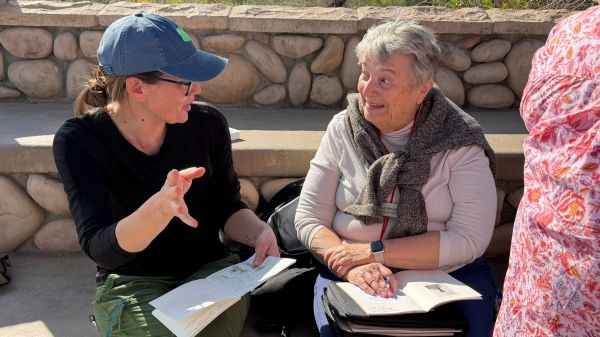
Danielle Edges (educator) and Dena Trangsrud (Mirabella) sharing journal entries and discussing drawing techniques they are practicing. Photo credit: Molina Walters
Weaving Environmental Education and Civic Voice
Another powerful moment during the Institute came when we explored the intersection of environmental education and civics education. I have long worked at that intersection, but the Institute sharpened my understanding of why it matters so deeply. Environmental education builds ecological literacy. Civics education builds voice and participation. The Institute challenged us to consider what happens when these are intentionally woven together.
In Desert Futures, participants observe seasonal shifts, reflect on desert adaptations, and share stories of environmental change across generations. After the Institute, I began explicitly naming these moments as civic acts. When an elder shares how monsoon patterns have changed over decades, that is not simply memory. It is civic testimony. When a student describes noticing pollinators return after rainfall, that is not just observation. It is environmental interpretation that shapes public understanding.
The Institute gave me the language to frame storytelling as civic imagination in practice. That reframing empowered participants. They began to see themselves not only as learners but as contributors to environmental dialogue.
Examining Power and Shared Ownership

ASU student (Aria Edges), educator (Shalyn Lowe) and a Mirabella resident (Andrea Michaels) sharing learning experiences from nature journaling. Photo credit: Molina Walters
One of the most challenging and necessary parts of the Institute involved examining power. Who defines the goals of a project? Who benefits from participation? Who holds knowledge?
Those questions followed me after the Institute.
Desert Futures is intentionally intergenerational. Yet I had to ask myself whether academic structures were unintentionally shaping the space more than lived experience. Were elders being invited to share stories, or were they being positioned as “guest speakers” in an academic environment? After the Institute, I shifted the structure of several sessions. Instead of leading with predetermined themes, I began opening gatherings with participant-driven reflections. I also built in more informal conversation time, allowing relationships to form beyond structured prompts. The impact was immediate. Participants began referencing one another’s stories in later sessions. Students expressed greater confidence in facilitating discussion. Elders reported feeling valued rather than observed.
The Institute reminded me that reciprocity is not an abstract principle. It is visible in how space is held.
Embracing Iteration and Responsiveness
Perhaps the most liberating insight from the four days in August was the affirmation that community-based work is iterative. The Institute created space to share uncertainties with other Fellows. Hearing their challenges normalized my own. There were moments when participation fluctuated. Scheduling was complex. Energy levels varied. Earlier in my career, I might have interpreted these as setbacks. Through the Institute, I began to see them as information.
Leadership, I learned, is responsiveness.
I returned to Desert Futures more comfortable with adaptation. When sessions felt too structured, I adjusted. When conversations lingered in unexpected directions, I followed. Rather than measuring success solely by deliverables, I began paying closer attention to shifts in confidence, voice, and connection.
Recognizing Quiet Transformations
One participant recently shared, “I’ve lived here for 20 years, but this is the first time I’ve felt like my experience of this place mattered.”
Before the Institute, I might have celebrated that as a positive comment. After the Institute, I recognize it as evidence of civic belonging taking root. Students who initially hesitated to speak now lead storytelling prompts. Participants who once described themselves as “not outdoorsy” return with careful ecological observations. Conversations move naturally from memory to responsibility to possibility.
These are not dramatic transformations. They are steady ones.
The Institute helped me see that impact often unfolds quietly. It grows in confidence, in shared laughter, in collective silence while watching a desert sunset.
Leading from Within
The most significant change the Leadership Institute created was internal.
I no longer feel compelled to lead from the front. I am more committed to creating circles where leadership is shared. I am more attentive to who speaks and who remains quiet. I am more patient with ambiguity. Desert Futures continues to evolve. But it now does so with a clearer foundation rooted in listening, belonging, and civic imagination.

Kasey Weingarten (educator) and Barbara Carpenter (Mirabella resident) sharing stories about their journaling experience. Photo credit: Molina Walters
If there is one lesson I carry forward from those four days in August, it is this: meaningful community action does not begin with strategy. It begins with a relationship.
The Sonoran Desert has always taught me that resilience is built slowly. The Leadership Institute reminded me that civic resilience is built the same way.
By listening first.

A gathering of Desert Futures: Voices of the Desert participants at the Gilbert Riparian to share their favorite drawing, the story behind it and what they are learning from the experience. Photo credit: Molina Walters