Thinking Through Water Leadership: Insights from the Colorado Plateau




Editor's note: This community-contributed post highlights one approach to designing a leadership development program through multi-institutional collaboration. We share it as a perspective from the field that may offer ideas for others developing professional learning programs. The program described is not affiliated with or run by NAAEE.
This blog was written by Miriam Nelson, Elina Gentilhomme, Lucero Radonic, and the Arizona Water Leadership Consortium, which includes Kait Bieber, Noa Bruhis, Carol Jordão, Anélyse Regelbrugge, Mariana Rivera Torres, Nieves Vazquez, in addition to the three other authors of this piece.
From high alpine forests to dramatic zones of geologic uplift to vast shrublands, the Colorado Plateau holds an astonishing sweep of ecosystems and cultures across the Four Corners area of the Southwestern United States. These landscapes are shaped—and sometimes constrained—by one common element: water. As climate variability intensifies and communities confront aging infrastructure, different levels of water regulations, questions of water access, quality, and quantity move from background context to front-page decisions. Ensuring water security for future generations is not a simple individual task, it’s a collective practice that asks leaders to work across different spaces with integrity, persistence, and respect.
Over the last year, we have been part of a large multi-institutional working group designing a pilot Water Leadership Institute (WLI) to support early and mid-career water leaders across Northern Arizona. Following the introduction of the WLI in Southern Arizona in 2024 and the program’s decade-long history in California's Central Valley–co-led by the Environmental Defense Fund—the Northern Arizona pilot is currently being tailored to the specific needs and strengths of the region.
An advisory board of water experts and leaders has shaped the effort at every turn, providing guidance and rich insights. Throughout the last six months of virtual sessions and in-person meetings, we have asked the board what skills leaders must develop to build lasting water security in the area. In tandem with the efforts of the working group and advisory board, with funding from Arizona Water for All (AW4A), our research team at Northern Arizona University (NAU) interviewed over 30 practitioners from multiple water-related sectors to help us identify the range of skills associated with good water leadership in this region.
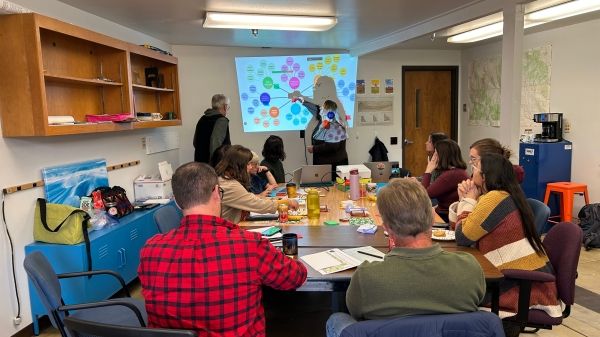
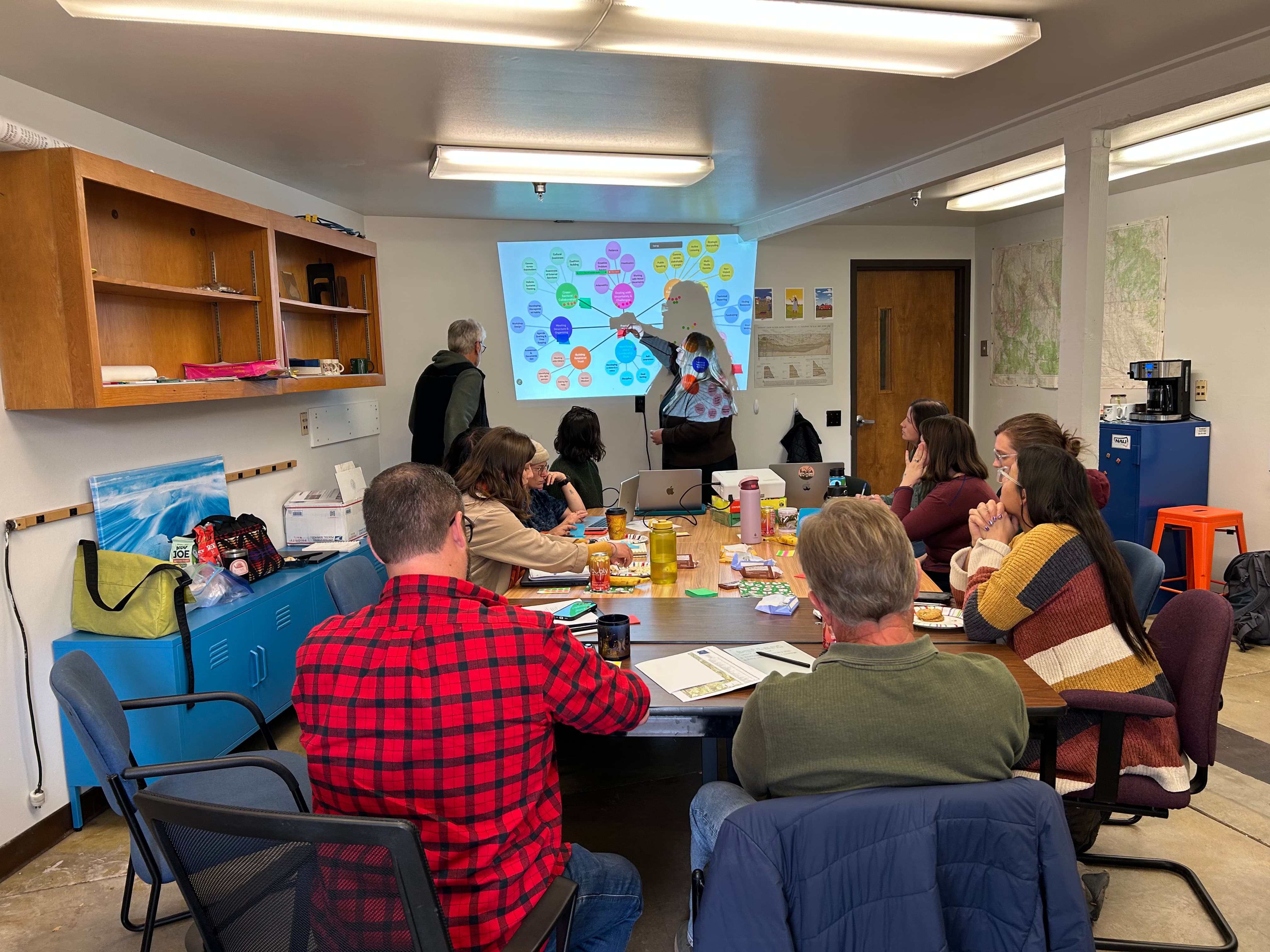
We brought these insights, in the form of a bubble map (Figure 1), to our advisory board at a chilly November meeting. Our small office space at Northern Arizona University (NAU) was crammed with snacks, coffee, and the excitement of working together for a water secure future.
Using a projector, we screened this map onto one of our empty office walls. “Choose the two themes you believe matter most for water leadership in Northern Arizona”, we asked, giving them sticky dots to mark their choices. The 12 board members got up with some hesitation, pondering how to choose only two when so many factors come into play around successful leadership. They talked amongst themselves, lively with debate and suggestions, until everyone was back in their seats. Looking at the board, three major themes stood out: Cross-Sectoral Collaboration, Effective Communication, and Navigating Uncertainty.
Place-Based Leadership
We talked through these three selected skill areas, examining what made them so crucial to this specific place, the Colorado Plateau of Arizona. In effect, the ecological and cultural diversity of the region makes it so that water users (and forms of infrastructure) have very different needs, uses, and impacts. To be able to work towards a more water secure future, effective water leadership is reliant on strong cross-sectoral relationships to bridge these diverse needs and manage uncertainties around existing data gaps as well as future climate and policy scenarios.
However, to focus solely on strong cross-sectoral relationships would mean overlooking the underpinning skills that are required to build those relations—most importantly, relational trust. Relational trust represents a collaborative process through which an individual seeks others’ perspectives and expertise, establishing interpersonal connections through active listening and acting with integrity–in essence, “walking their talk," and walking with others.
As demonstrated in Figure 1, the gray bubbles represent the sticky notes advisory board members added to each category where they thought a skill was missing.
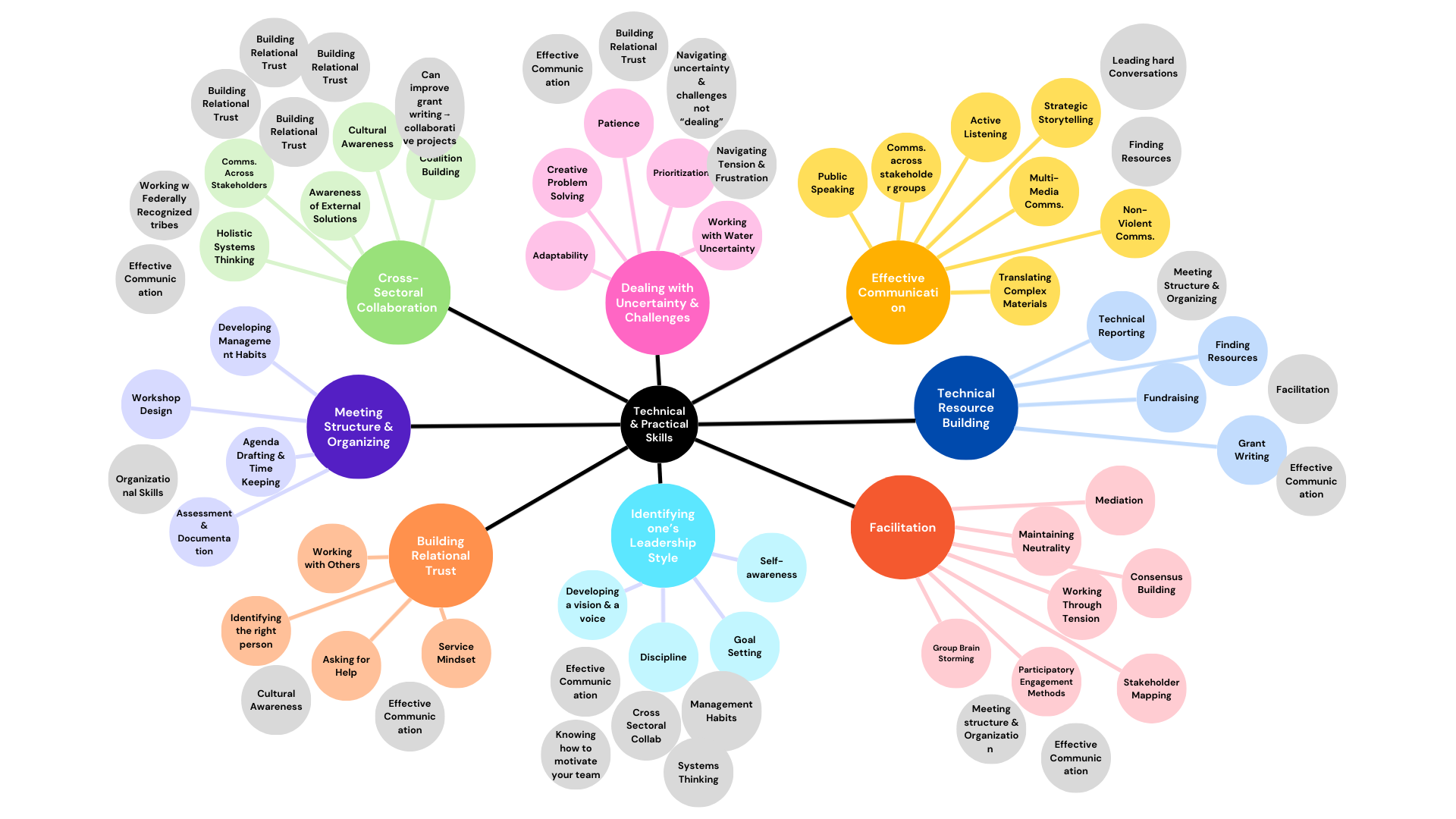
Building relational trust was added time and time again to the cross-sectoral collaboration section, emphasizing how important it is. Furthermore, across our research interviews and the advisory board discussions, this skill was woven into how leaders collaborate, communicate, and make decisions in the face of uncertainty. Together, these interconnected skills describe leadership not as a solely technical act but as an ongoing, relational practice.
Practical Implementation and Looking Ahead
The above skill areas offer a way of envisioning program development and outcomes with the aim of fostering confident leaders in the water world. The four core elements highlighted here will be entwined into every element of the Water Leadership Institute as the working group continues to design the curriculum for the program, which will run in the early summer of 2026. We offer our process and what we learned from it for consideration in the design of placed-based environmental leadership programs in other regions.
Ensuring the inclusion of different values, experiences, and voices is essential for managing water resources into the future. As we look for ways to further household water security for future generations, emerging leaders offer a pathway forward—addressing challenges by working together.
Acknowledgement of Collaborative Design
We would like to thank our Water Leadership Institute Advisory Board members for sharing their knowledge and ongoing assistance. Thank you to Jessica Archibald, Michellsey Benally, Lisa Clark, Ada Cohen, Nikki Cooley, Ron Doba, Mariessa Fowler, Ashley Gries, Lanier Nabahe, John Snickers, Erik Stanfield, and Fabiola Torres Toledo. Lastly, our sincere thanks to everyone who participated in the Regional Landscape Analysis.