Strengthening Urban Environmental Education: Framing Learning Through a Complexity Lens



Date: Friday, September 11, 2026
Time: 12:00 PM Central Time / 1:00 PM Eastern Time
Platform: Zoom
Register Today
This webinar will take place at 12:00 PM CT / 1:00 PM ET on September 11th via Zoom.
A central aim of environmental education is to strengthen human-nature connections in order to support transformative changes that help address myriad environmental crises facing our planet. To fulfill this ambitious goal, effective environmental education needs to move away from a dominant focus on linear pro-environmental behavior change models that promote environmental action without attention to multi-scale interactions. Instead, the field needs to apply robust, complexity-oriented approaches that support nested and multi-scale interactions between people and place. In this talk, Marijke Hecht will present a conceptual learning ecosystem framework that draws on concepts from the ecological sciences (e.g., use of ecological levels of organization) as a starting point for how we might successfully address complexity issues in education like relationality, uncertainty and emergence. She will then present preliminary findings from a designed-based research project in Cleveland, Ohio that aimed to support educators as keystone actors working on urban environmental action projects. Marijke Hecht will then invite session participants to explore additional strategies for strengthening environmental learning ecosystems.
Guest speaker:
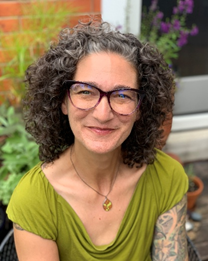 Marijke Hecht is Assistant Professor of Environmental Education in the School of Environment and Natural Resources at The Ohio State University. Her research focuses on urban communities where she works collaboratively with educators and youth on design-based research to understand and develop pathways towards more just environmental futures. She explores questions of environmental identity, environmental literacy about complex ecological issues, and the structure and function of learning ecosystems. Prior to her work in academia, she taught middle and high school math and science in her hometown of New York City and led environmental restoration projects and outdoor environmental education in Pittsburgh’s city parks. She received her PhD in Learning Sciences and Policy from the School of Education at the University of Pittsburgh and a Master of Science in Botany from the Field Naturalist program at the University of Vermont.
This webinar is funded by ee360+ (a consortium of 25 partners led by the North American Association for Environmental Education and funded by the US EPA).