Limiting Trash and Creating Treasure
In the CEE-Change, Together blog series, NAAEE shares narratives from the CEE-Change Fellows as they implement their community action projects and work to strengthen environmental education and civic engagement capabilities, all supporting the mission of cleaner air, land, and water. Join us on their journey! The Civics and Environmental Education (CEE) Change Fellowship is NAAEE’s initiative to support leadership and innovation in civics and environmental education in North America and beyond.
The 2025 U.S.-based CEE-Change Fellowship Program is supported by generous funding from ee360+, the Cedar Tree Foundation, the Sam and Mary Lawrence Foundation, and the Weeden Foundation. The 2025 International CEE-Change Fellowship Program is a partnership between NAAEE and the Global Environmental Education Partnership (GEEP).
In my last beach clean up in Hellshire Beach, Portmore, Jamaica in September 2025, I imagined the idea of turning trash into treasure. I thought about the impact of the accumulated waste, which could be converted from raw materials into creative pieces through the arts. This approach would surely encourage greater levels of civic responsibility among my students. The impact would be less stress on wastesheds and our seas would be happier for it.

Intercoastal Clean Up in Portmore, St. Catherine, Jamaica, September 2025. Photo by Nicole Kerr-Walker.

Trash to Treasure Promotion flyer. Created by Gemini AI.
The Entries
The Trash to Treasure Initiative aimed to challenge students and teachers to reduce and upcycle waste into functional gadgets as a means to protect the environment. Forty-five students and five teachers participated in this challenge, and there was both a student and adult category. The winners of the competition created a Flashbox from an upcycled shoe box, demonstrating how lenses could be used to project images from their phones in order to watch their favourite TV show on an enlarged screen!

The Flashbox (Projector) created from a shoebox was the winning entry at the Trash to Treasure Challenge. Photo by Nicole Kerr-Walker.

Challenge entries include a bag made from a mayonnaise Jar and and an irrigation system using low density polyethylene (LDPE) water bottles. Photo by Nicole Kerr-Walker.

LDPE pots for palm trees. Photo by Nicole Kerr-Walker.

Educational model of the heart made using upcycled materials. Photo by Daina Grant-Moncrieffe.
In the adult category, one science teacher converted a mayonnaise bottle into a fashionable bag and plastic bottles into irrigating systems and pots for plants. Another teacher encouraged her students to create models of the circulatory system for her biology class. The result of these science, technology, engineering, and mathematics (STEM) projects was to keep one less jar, less paper, and fewer plastic bottles from being aimlessly thrown into the wastesheds and waterways—ultimately protecting the earth’s ecosystem.
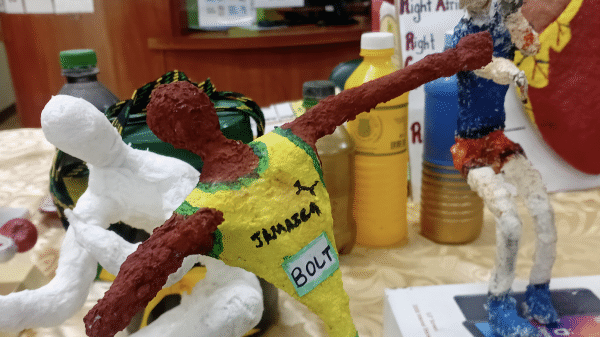
In addition, the art teacher challenged students to use aluminum foil, tissue, paper, and wood to make sculptures of famous athletes—such as Dr Honorable Usain Bolt and Lionel Messi—using papier-mache. The project with the largest impact was the Spanish teacher’s submission! He collaborated with his class to make a gaming board using discarded bottle caps. He strongly believed that he and his class made an impact on the environment. “Collecting 5,000 bottle caps over the years means there are 5,000 fewer out there to litter and damage the environment.” Persistent daily habits can lead to diverting 5,000 pieces of plastic from our rivers, mangroves, and beaches.

Usain Bolt Sculpture made from waste aluminum foil, tissue, paper, and wood. Photo by Nicole Kerr-Walker.

Gaming board made from plastic corks. Photo by Nicole Kerr-Walker.
Early Outcomes and Challenges
The pieces created showed that students were excited and engaged. They demonstrated collaboration and courage. I was hoping for more entries and more participation in this project. This would meet my goal of preventing mindless disposal of waste by encouraging students’ creativity in transforming waste into functional art, one trash at a time, becoming “defenders of the earth”.
Multiple calls were made. Changes were made to the competition. However, there was no change in the number of projects obtained. There were too many other competing factors drawing for their attention and time. Possibly apathy also played a role. I had to regroup. I had to find collaborators to encourage buy-in.
CEE-Change Impact
As a CEE-Change fellow 2025, attending sessions about the use of the outreach plan to target different audiences and how to evaluate the project at different intervals, resulted in the development of skills needed to move the project forward. Implementing the strategies learnt in these sessions resulted in the morphing of the project. The most impactful professional development seminar was on fundraising, where I learnt that sponsors are just waiting to be asked. I had significant drawbacks to seeking sponsorship for fear of rejection. However, the sponsors responded! The gifts (treasures) they sent were encouraging. Their response demonstrated that organizations are ready to champion the cause for environmental action and incentivizing responsibility.
The surprising link coming from the community action project was a sudden turn of events, which turned into an opportunity for students to be change agents. A small group of interested students and teachers was convened to recognize Earth Day 2026. In our meeting and conversations, we were able to brainstorm: a bottle drive and keynote address by the Director of the School Recycling Programme from the Recycling Partners of Jamaica. The director addressed our school population on the importance of recycling plastics and transforming the bottles into useful materials, such as shoes and clothing.

Teachers and students of St. Jago High receive receptacles for plastics from Mrs Petrina Graham-Kerr from the Recycling Partners of Jamaica on Earth Day. Photo by Shaniel Scarlett.
The community action project pleasantly morphed beyond the use of art through upcycling into an active collection of plastic bottles. Students were actively scurrying to find bottles, placing them into receptacles provided by the Recycling Partners of Jamaica. They were modelling responsible behaviour: one bottle at a time. The winner was promised a cash incentive! The surge in participation highlights the strategic need for external motivators of behavioral change.
It would appear that the slow pace of collecting waste is the first phase of the Trash to Treasure Initiative. Creating the treasure is another! It is my intent to continue advocating for the Trash to Treasure Initiative on a larger scale, where schools and clubs can creatively upcycle wastes. The reduction of waste will compound over time. One of the winners, when interviewed, shared that “small things that seem ordinary can be created into something that can be used forever” and he is looking forward to the competition next year.
Making one small change at a time and encouraging students to protect their environment through the arts and through meaningful incentives is just the start to limiting trash and converting it into treasure.
Update from October 2026: I recently attended the Association of Science Teachers of Jamaica's 76th Conference and presented a poster on Trash to Treasures. The Association’s President and Vice President also held a competition among teachers: “From Trashables to Fashionables.” See photos from the conference and the winning piece below.

Dr. Debbie Devonish standing by the poster she and Nicole collaborated on for the Association of Science Teachers of Jamaica's 76th Conference. Photo credit: Nicole Kerr-Walker.

Nicole speaking about NAAEE at the Association of Science Teachers of Jamaica's 76th Conference. Photo credit: Nicole Kerr-Walker.

The “From Trashables to Fashionables” winning piece made out of plastic and plastic caps. Photo credit: Nicole Kerr-Walker.

The “From Trashables to Fashionables” winning piece next to Nicole’s poster. Photo credit: Nicole Kerr-Walker.

Nicole’s mentor, Elaine Williams (left), and Nicole standing by the Trash to Treasure poster and “From Trashables to Fashionables” winning entry at the Association of Science Teachers of Jamaica's 76th Conference. Photo credit: Nicole Kerr-Walker.