Connecting Higher Education to the Environmental Education Community
This blog post was written by Becca Franzen, Laura Downey, Katie Navin, and Brittany Wray.
Environmental education is strongest when it’s connected across sectors, generations, and ways of knowing. One of the most powerful (and often underdeveloped) connections is between higher education and state or provincial environmental education associations, referred to as Affiliates of the North American Association for Environmental Education (NAAEE). This blog emerges from a growing community working to strengthen that connection. Through the ee360+ initiative, there has been an increase focus on building the capacity of higher education faculty and staff. As a training partner, the University of Wisconsin–Stevens Point is helping lead this effort by:
• connecting higher education faculty and staff through statewide networks
• offering professional development and community-building opportunities (like monthly webinars)
• supporting higher education programs as they pursue accreditation

Higher education faculty explore Project Learning Tree activities at an environmental education workshop hosted by WAEE. Photo by Wisconsin Association for Environmental Education (WAEE).
This work is deeply collaborative. It includes a cohort of 10 “state instigators”—leaders who are each developing a statewide higher education network for faculty who incorporate environmental education. Through ee360+, these instigators have built a community of practice, coming together to explore needs, identify barriers, and share strategies for success while actively strengthening their local networks. Each state is approaching this work in its own way, offering inspiration and practical models for others.
Some of the instigators are professors, while others are employed by their state affiliate and are part of the Affiliate Network. The Affiliate Network of NAAEE is composed of more than 50 state, provincial, and regional organizations across North America. The network collaborates on trainings, policy issues, and resources to support EE across the continent and in their own communities. This blog focuses on the value of connecting higher education networks with the affiliate network.
Shared Benefits: Why This Connection Matters
At its best, a higher education–EE Affiliate partnership is mutually reinforcing.
For higher education institutions, this connection offers:
- A built-in network of partners across nonprofits, schools, agencies, and communities
- Real-world relevance for students through applied, place-based learning
- Professional pathways through alignment with certification programs
- Access to professional learning
- Increased awareness of higher education accreditation in environmental education
For EE Associations, the benefits are just as significant:
- Stronger, more diverse networks that include faculty, researchers, and students
- A pipeline of emerging professionals entering the field
- Access to research and evaluation expertise
- Deeper engagement at conferences and events

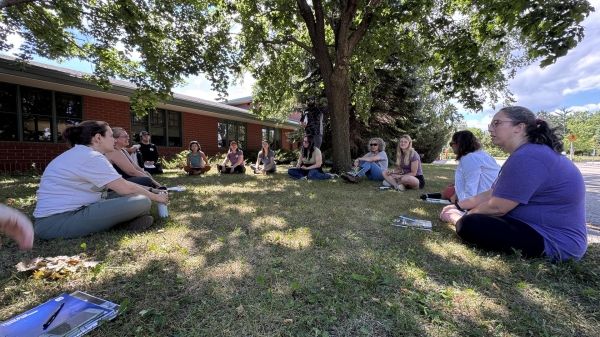
Participant groups planning to share out about environmental education activities they could use in the classroom. Photo by Wisconsin Association for Environmental Education (WAEE).
Emerging Examples from the Field
These snapshots showcase how different approaches are taking shape in practice, offering inspiration, lessons learned, and adaptable ideas for building higher education networks in your own context.
Colorado: Aligning Coursework with Certification
In Colorado, higher education programs have partnered with the Colorado Alliance for Environmental Education (CAEE) to align coursework with the state Affiliate’s environmental education certification program, creating clear, applied pathways into the field.
An example is the Walking Mountains Fellowship program at Walking Mountains Science Center. This multi-faceted graduate fellowship is a full-time, 2-year and 3-month professional development program focused on K–8 field science education, leadership, and nonprofit capacity building. Fellows teach summer science camps and school field science programs while earning a Master of Arts in Science Education through the University of Northern Colorado. Through this integrated model, fellows gain extensive hands-on teaching experience while progressing toward educator certification and advanced credentials as a cohort.
Through these collaborations:
- college/university coursework and field experiences are mapped directly to certification competencies
- students and fellows can complete certification requirements alongside their academic programs
- graduates enter the workforce already certified—or well on their way.
Impact:
Participants gain a clear, practice-based professional pathway, and the state continues to build a stronger, more skilled network of environmental educators prepared to lead high-quality, research-informed programs.
Kentucky: eeHEN Network
In Kentucky, the Kentucky Association for Environmental Education (KAEE) supports the Environmental Education Higher Education Network (eeHEN). The eeHEN serves as an interdisciplinary hub for faculty and staff who integrate environmental education into their courses or programs.
What the Partnership Looks Like
KAEE intentionally recruits across a vast spectrum of disciplines—including engineering, chemistry, forestry, early childhood education, and recreation. This cross-disciplinary approach allows the network to weave environmental literacy into diverse academic pathways across the state. There are tiers of engagement in the community. At its core is the eeHEN Action Team, a smaller dedicated team that is responsible for implementing strategic priorities aligned with KAEE’s overarching strategic plan and planning meetings. The action team supports a broader network of over 50 higher education professionals who receive ongoing updates and collaboration opportunities relevant to their work without requiring a demanding time commitment.
The network gathers twice a year. These bi-annual meetings provide a vital forum for faculty and staff to share resources, brainstorm innovative ideas, and build lasting partnerships both within and across their respective institutions.
Impact
As a result of this partnership, we are seeing more EE being incorporated into courses, increased collaboration across institutions, and more involvement by higher education professionals in the great EE network across Kentucky. It has also allowed us to create a pathway of learning from early childhood to adult, aligning student learning with the demands of Kentucky’s growing green economy. By creating a seamless transition from student to professional, we ensure our graduates are prepared to manage Kentucky’s resources in a way that meets our vision of a sustainable future.
Kansas: Conservation and Environmental Education
The Kansas Association for Conservation and Environmental Education (KACEE) has been working to build a collaborative group of Kansas university faculty and staff working to advance environmental education (EE) across higher education institutions in the state. This newly formed Kansas eeHigher Education Network includes representatives from Pittsburg State University (PSU), Friends University, Fort Hays State University (FHSU), and Kansas State University (KSU), each bringing distinct approaches—from EE certificates and interdisciplinary tracks to integration within science education methods courses and preservice teacher training.
What the Partnership Looks Like
Each institution contributes unique strengths: PSU is developing a dedicated EE certificate; Friends University has built an interdisciplinary EE track connected to local schools; FHSU weaves EE into elementary methods courses and is exploring innovative tools like 360-degree video (which records all views at the same time—up, down, side-to-side—allowing for virtual 3-D exploration); and KSU offers EE coursework with hands-on certifications and community practicum experiences. The network convenes to share these approaches, identify shared challenges, and explore what collaboration could make possible.
How the Partnership Benefits EE in Kansas
By connecting institutions that have historically worked in isolation, the network creates opportunities to pool resources, share curriculum strategies, and reach smaller or more rural school districts through partners like regional educational service centers. It also strengthens pathways between higher education and field-based employers—state agencies, NGOs, nature centers, zoos, and national parks—helping students more clearly see professional opportunities in EE.
Potential Impacts
- Broader student exposure to EE as both a discipline and a career, particularly among students who currently have no awareness of the field
- Stronger preservice teacher preparation, building confidence in outdoor and place-based teaching before educators enter classrooms
- Community engagement through citizen science initiatives that leverage universities as trusted knowledge institutions
- Collaborative research and grant funding that no single institution could pursue alone
- Network expansion to include Wichita State University, University of Kansas, education department faculty, and community and media partners, amplifying the reach and visibility of EE across Kansas

Full group photo of higher education faculty workshop attendees. Photo by Wisconsin Association for Environmental Education (WAEE).
Getting Started in Your State
Higher education networks offer a practical way to connect those preparing to enter the field with those already shaping it. For Affiliates of the North American Association for Environmental Education, this is an opportunity to strengthen the field from within, building alignment, expanding partnerships, and supporting the next generation of environmental educators.
If you’re an Affiliate interested in building a higher education network, start simple:
- Convene an initial group of interested faculty and partners. What insights can this group offer about what might be beneficial to connect higher education with Affiliates?
- Identify shared goals and opportunities. For example, higher education faculty and staff might be seeking resources for EE and Affiliates might offer resources (such as being the state coordinator for Project WET, WILD, or Learning Tree).
- Pilot one or two activities (e.g., a meeting, training, or conference session). For example, host a Project facilitator training workshop for higher education faculty.
- Build from what works. Get feedback from the pilot and continue to develop plans based on the successes.
There’s no single model—what matters most is creating a space for connection and shared purpose. The connection is already there. This blog is an invitation to make it visible, intentional, and impactful.
This eePRO blog series, Ripple Effect, highlights stories of collaboration and impact among partners in the ee360+ Leadership and Training Collaborative. ee360+ is an ambitious multi-year initiative that connects, trains, and promotes innovative leaders dedicated to using the power of education to create a more healthy and sustainable future for everyone, everywhere. Led by NAAEE, ee360+ is made possible through funding and support from U.S. EPA and twenty-five partner organizations representing universities and nonprofits across the country, as well as five federal agencies. Through this partnership, ee360+ brings together more than five decades of expertise to grow and strengthen the environmental education field.